
Airbnb does not treat emotional support animals the same as service animals: service animals must be accepted everywhere and can never carry a pet fee, while ESAs are handled as pets unless local law says otherwise. In California, New York, Quebec, and Ontario, Airbnb’s own policy requires hosts to accommodate ESAs regardless of a listing’s general pet rules. Outside those places, whether your emotional support animal travels with you at an Airbnb often comes down to the individual host, not federal law.
TL;DR:
- Hosts in California, New York, Quebec, and Ontario must accept emotional support animals under Airbnb’s policies, aligning with local laws that extend housing protections.
- Service animals are always accepted without pet fees and do not require documentation, whereas ESAs are treated as pets outside these jurisdictions, subject to host policies and fees.
- Hosts can only ask if the animal is necessary for a disability and what task it performs, with no legal ability to request certificates or registration paperwork.
- Proper pre-booking communication, including informing hosts about your ESA and confirming control and housebreaking, can prevent most conflicts.
- If denied an ESA or unfairly charged, travelers should document interactions, reference Airbnb policies, and escalate through Airbnb or legal channels if needed.
Table of Contents
- Airbnb Emotional Support Animal Rules: Service Animals vs. ESAs
- Where Airbnb Requires Hosts to Accept ESAs
- Fees, Documentation, Disclosure, and What Your Animal Needs to Do
- Your Pre-Booking and Arrival Checklist
- When Hosts Can Say No: Exemptions and Special Situations
- What to Do If a Host Denies Your ESA or Charges an Improper Fee
- A Note on Traveling With Your ESA Without Making It a Fight
- How Supportpet Helps You Travel With Confidence
- Sources
- FAQ
Airbnb Emotional Support Animal Rules: Service Animals vs. ESAs
Airbnb draws a hard line between two categories of animals, and that line determines almost everything else in this article. A service animal, under Airbnb’s Accessibility Policy, is trained to perform a specific task related to a disability, a guide dog navigating traffic, a psychiatric service dog interrupting a panic episode. Airbnb does not classify these animals as pets. An emotional support animal, by contrast, offers comfort through its presence rather than a trained task, which is exactly what makes ESAs so valuable for anxiety, depression, and PTSD, but also why Airbnb slots them into a different policy bucket.
That distinction shapes three practical rules:
- Documentation: Airbnb does not let hosts demand certificates, doctor’s notes, or ESA registration for either category. This mirrors the standard set under the ADA’s guidance on service animals, which also bars businesses from requiring paperwork.
- The two-question rule: Hosts may only ask whether the animal is needed because of a disability and what task it performs. For emotional support animals, since there’s no trained task, this question typically has no meaningful answer, which itself signals ESA status to a host.
- Fees: Service animals can never be charged a pet or cleaning fee. ESAs can be, unless the reservation falls inside a jurisdiction where Airbnb requires ESA accommodation.
The practical result: your emotional support dog on Airbnb gets treated like any other pet at most listings, subject to that host’s pet policy, breed restrictions, and fees, unless you’re booking somewhere the platform has carved out a specific exception.
Where Airbnb Requires Hosts to Accept ESAs
Airbnb’s policy names a few places where the ESA-as-pet default flips, including California, New York, Quebec, and Ontario for various types of reservations. In these jurisdictions, hosts must accept emotional support animals under the same terms as service animals, no blanket “no pets” rule, no ESA-specific fee, according to the Accessibility Policy.
Why only these four? Each has state or provincial law extending housing-style protections to assistance animals, including ESAs, beyond what federal law requires. Airbnb built its policy to track that legal reality rather than invent its own broader standard.
This creates what’s essentially a hybrid system: one global baseline policy, adjusted wherever local law demands more. A few things follow from that setup:
- Airbnb’s named list is not exhaustive of every place with assistance-animal housing protections. Local ordinances change, and new state laws get passed after major platform policies are last updated.
- If you’re booking outside California, New York, Quebec, or Ontario, don’t assume protection extends automatically. Check the specific state, provincial, or municipal law governing short-term rentals in your destination before you count on ESA accommodation.
- A quick call to a local tenant rights organization or a look at your destination’s housing authority page can confirm whether short-term rentals fall under the same assistance-animal rules as long-term leases, since that varies too.
Fees, Documentation, Disclosure, and What Your Animal Needs to Do
Here’s the operational reality once you’ve confirmed where you’re booking. Service animals never carry a pet fee, anywhere, full stop. ESAs can be charged a standard pet fee everywhere except the four jurisdictions above, where they’re treated exactly like service animals for fee purposes.
Hosts are boxed in on what they can ask. The two-question rule is the ceiling, not a suggestion:
- Is the animal required because of a disability? A yes/no question, nothing more.
- What work or task has the animal been trained to perform? For an ESA, there typically isn’t a trained task, and that’s fine; Airbnb doesn’t let hosts penalize you for that answer.
What hosts cannot do: request a doctor’s letter, ask for ESA registration paperwork, or ask you to demonstrate the animal’s training. The Accessibility Policy is explicit that documentation is never a condition of acceptance.
Your side of the bargain is behavioral. Airbnb expects any accompanying animal, service or ESA, to be housebroken, under your control, and never left alone in the unit without the host’s prior approval. A host asking you to keep the animal on a leash in shared hallways or common areas is enforcing a reasonable, permitted rule, not discriminating. A host refusing you outright because they’d “rather not deal with animals,” in a jurisdiction where your ESA is protected, crosses into discriminatory territory.

Pro Tip: Keep your host’s fee question and your ESA’s legal status separate in your head. Even in a protected jurisdiction, you can still be charged for actual damage the animal causes. What you can’t be charged is a blanket fee just for having the animal there.
Your Pre-Booking and Arrival Checklist
Most conflicts over emotional support animals at Airbnb properties trace back to a missed step before check-in, not a policy violation at the door. Building the habit of this checklist prevents the fire drill.
- Read the House Rules section closely. Some listings state pet policies explicitly; others say nothing, which isn’t the same as a guarantee.
- Message the host before booking, not after. State plainly that you travel with an emotional support animal for a disability-related need, and confirm the animal is housebroken and will be under your control.
- Skip the medical details. You don’t need to name a diagnosis or explain your condition. “I have a disability-related need for my ESA” is sufficient and keeps the conversation focused on logistics.
- Ask about building-specific rules, especially for condo or apartment-style listings where a homeowners’ association or building management might have separate pet restrictions layered on top of the host’s own policy.
- Skip the instant online “ESA letter” mills. A legitimate ESA recommendation comes from a licensed clinician who has actually evaluated you, and most jurisdictions don’t recognize generic, no-relationship online certificates as valid anyway.
- At check-in, introduce the animal to the host directly if you’re meeting in person, and confirm any boundaries, off-limits rooms, quiet hours, whatever the host raises.
- If a host balks at any point, don’t argue in person. Save the conversation in writing, screenshot the listing’s stated pet policy, and request Airbnb’s mediation rather than escalating the disagreement yourself.
Pro Tip: Screenshot your pre-booking message thread the moment you send it, before check-in, not after a dispute starts. Airbnb’s mediation team works faster with a timestamped record than with your recollection of a conversation.
When Hosts Can Say No: Exemptions and Special Situations
Airbnb’s policy isn’t absolute. A host can request a formal exemption when a specific animal would pose a direct threat to health or safety, a documented, severe allergy in a shared-ventilation unit, for instance, rather than a general aversion to animals. Airbnb reviews and approves these exemptions case by case; a host can’t simply declare one unilaterally.
A few situations worth understanding before you book:
- Severe allergy claims typically need to point to a specific, serious medical risk, not a vague preference, and Airbnb weighs this against your accommodation need rather than granting automatic host veto power.
- Shared spaces like a shared bathroom or common kitchen in a co-hosted listing may come with reasonable leashing or containment expectations that wouldn’t apply in a private, whole-unit rental.
- International bookings add another layer entirely: Airbnb’s own policy is a global baseline, but many countries have no equivalent to the ADA or the Fair Housing Act, so your protections abroad may be thinner than at home. Always verify destination-specific rules before assuming U.S. standards travel with you.
What to Do If a Host Denies Your ESA or Charges an Improper Fee
Don’t argue the point in the moment. Step back, document everything, and let Airbnb’s process do the work.
- Save every message. Screenshot the conversation where you disclosed your ESA, the host’s response, and the listing’s House Rules page as it appeared when you booked.
- Cite the specific policy. Reference the two-question rule and Airbnb’s Accessibility Policy directly in your message to the host, calmly, once. This creates a paper trail that helps Airbnb’s team assess the case quickly.
- Report it to Airbnb through the Help Center, including your reservation number, the listing link, and your saved screenshots. Airbnb’s resolution team can issue refunds, help relocate you to a comparable listing, or apply penalties to the host depending on severity.
- If it’s a housing-adjacent denial involving longer-term stays or a jurisdiction with strong assistance-animal housing law, a local fair housing agency or HUD’s Fair Housing Act overview is the right next stop. The Department of Justice’s Fair Housing Act enforcement page outlines when a complaint moves beyond a platform dispute into a legal one.
Airbnb’s internal resolution typically moves faster than any government channel, often within days for straightforward fee disputes. Legal or housing-agency routes take longer but carry more weight for repeated or severe violations.
A Note on Traveling With Your ESA Without Making It a Fight
The strongest position you can take with a host isn’t a legal one, it’s a clear one. Most hosts who push back on an emotional support animal aren’t trying to discriminate; they’re anxious about damage, allergies, or previous bad experiences with an unruly pet. A message like “I travel with an ESA for a disability-related need, she’s crate-trained and never left alone in the unit” does more to defuse tension than quoting policy language ever will.
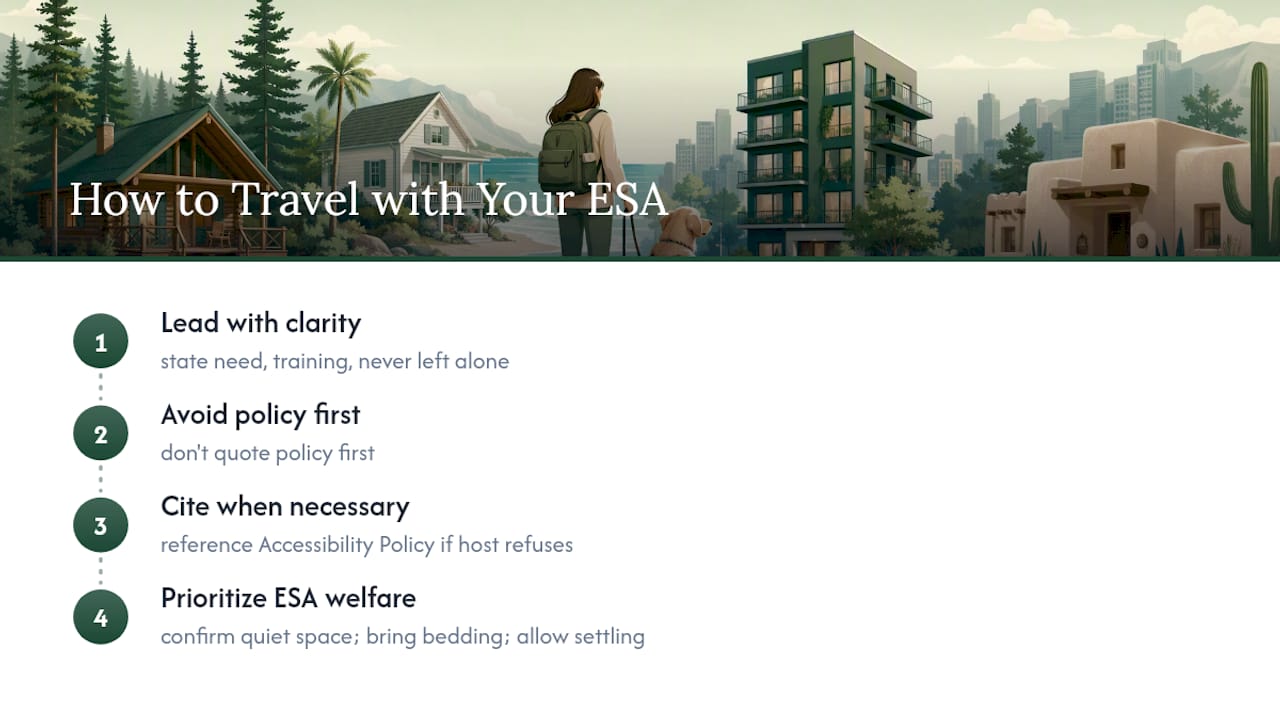
Save the citations for when good faith runs out. If a host still says no in a jurisdiction where your ESA is protected, that’s the moment to reference the Accessibility Policy directly, not the opening line of your first message.
And take the welfare half of this seriously. A long flight, an unfamiliar unit, and a stressed host make a bad combination for an anxious animal. Confirm quiet space, bring familiar bedding, and give your ESA time to settle before you need it to actually help you.
— Erik
How Supportpet Helps You Travel With Confidence
Sorting through Airbnb’s fee rules and jurisdictional exceptions is only half the challenge, the other half is making sure your ESA status itself is solid before you ever book a trip. There are resources that provide plain-language guidance on qualifying for an ESA, what a legitimate clinician-issued letter actually requires, and how to spot the instant-certificate scams that won’t hold up if a host or landlord ever pushes back.
If you already have a valid ESA letter from a licensed clinician, you’re set for the checklist above. If you don’t, or you’re not sure whether the one you have would survive scrutiny, Supportpet’s rights guide walks through what a real evaluation looks like and how housing and travel protections actually apply to you. DIY research gets most travelers most of the way there; a documented, clinician-backed letter is what closes the gap when a host or property manager asks hard questions. Start with the Supportpet before your next trip.
This article is general information, not a substitute for advice from a qualified doctor. Consult a qualified healthcare professional about your own circumstances before acting on anything here.
Sources
- Accessibility Policy - Airbnb Help Center
- ADA: Service animals resources
- U.S. Department of Justice: Fair Housing Act
- HUD: Fair Housing Act overview
FAQ
Can I bring my emotional support animal to an Airbnb?
Yes, but it depends on where you’re booking. Outside California, New York, Quebec, and Ontario, Airbnb treats your ESA as a pet subject to that host’s individual pet policy and fees, per the Accessibility Policy.
Is it illegal to deny a service animal?
Under the ADA, businesses generally cannot deny access to a trained service animal, and Airbnb’s own policy treats service animals as never subject to pet fees or blanket refusal.
Can an Airbnb host deny a guest with a service animal?
No. Airbnb policy prohibits hosts from refusing a guest because they’re traveling with a service animal, and a host who does so risks penalties through Airbnb’s resolution process.
Can Airbnb charge a pet fee for a service animal?
No. Service animals can never be charged a pet or cleaning fee under Airbnb’s policy, unlike emotional support animals, which can be charged a fee outside the jurisdictions where ESAs are specifically protected.