
Emotional support animals no longer have federal air-travel rights in the United States. The Department of Transportation reclassified ESAs as pets back in 2021, and that classification still stands in 2026. In practical terms: you either book your ESA as a pet and pay the fees, or you pursue psychiatric service dog status through task training to regain free cabin access under the Air Carrier Access Act.
TL;DR:
- Emotional support animals are now considered pets for air travel purposes and must be booked with a pet fee, typically $95 to $150 per flight segment.
- Airlines can enforce specific rules for service animals, such as requiring forms, harnesses, leash use, and limits on the number of animals per passenger.
- Only dogs that are individually trained to perform a specific task qualify as service animals under the federal definition; emotional support animals do not meet these criteria.
- International travel requires checking destination-specific import rules, which can involve lengthy paperwork and possible quarantine or denied entry.
- Fake documents like registration certificates or ID cards have no legal weight; only the DOT Service Animal Air Transportation Form with proof of task training is recognized by airlines.
Table of Contents
- What the DOT Final Rule Actually Requires
- How Airlines Treat ESAs Now: Fees, Carriers, and Denials
- Service Animals vs. ESAs: The Psychiatric Service Dog Path
- International Travel: Check Import Rules Before You Book
- Flying Your ESA as a Pet: A Step-by-Step Checklist
- Turning an ESA Into a Psychiatric Service Dog: What It Actually Takes
- Scams to Avoid: What Doesn’t Work for Air Travel Anymore
- An Editorial Take on Where This Rule Actually Lands
- Where to Get Help With the Paperwork That Actually Matters
- Sources
- FAQ
What the DOT Final Rule Actually Requires
The rule that changed everything defines a service animal narrowly: a dog individually trained to perform a specific task related to a disability. Nothing else qualifies, no matter how much comfort an animal provides. Emotional support animals, no matter the species, lost their ACAA protections and now travel under whatever pet policy the airline sets.
That shift gave airlines real authority to manage the process. Under the final rule, carriers can:
- Require the DOT Service Animal Air Transportation Form for any dog flying as a service animal
- Set submission windows, typically 48 to 72 hours before departure
- Limit the number of service animals per passenger
- Require a harness or leash at all times in the cabin
- Deny boarding to any animal that behaves aggressively or disruptively
One thing hasn’t changed: housing rights. The Fair Housing Act still recognizes ESAs for reasonable accommodation in rental housing. Air travel and housing run on two completely separate legal tracks now, and conflating them is where a lot of confusion starts.
How Airlines Treat ESAs Now: Fees, Carriers, and Denials
Your ESA flies as a pet, which means you’re paying pet-in-cabin fees just like anyone traveling with a cat or a small dog. Those fees typically run $95 to $150 per flight segment, and “segment” is the key word. A connecting flight isn’t one fee. It’s two, sometimes three, depending on your routing.
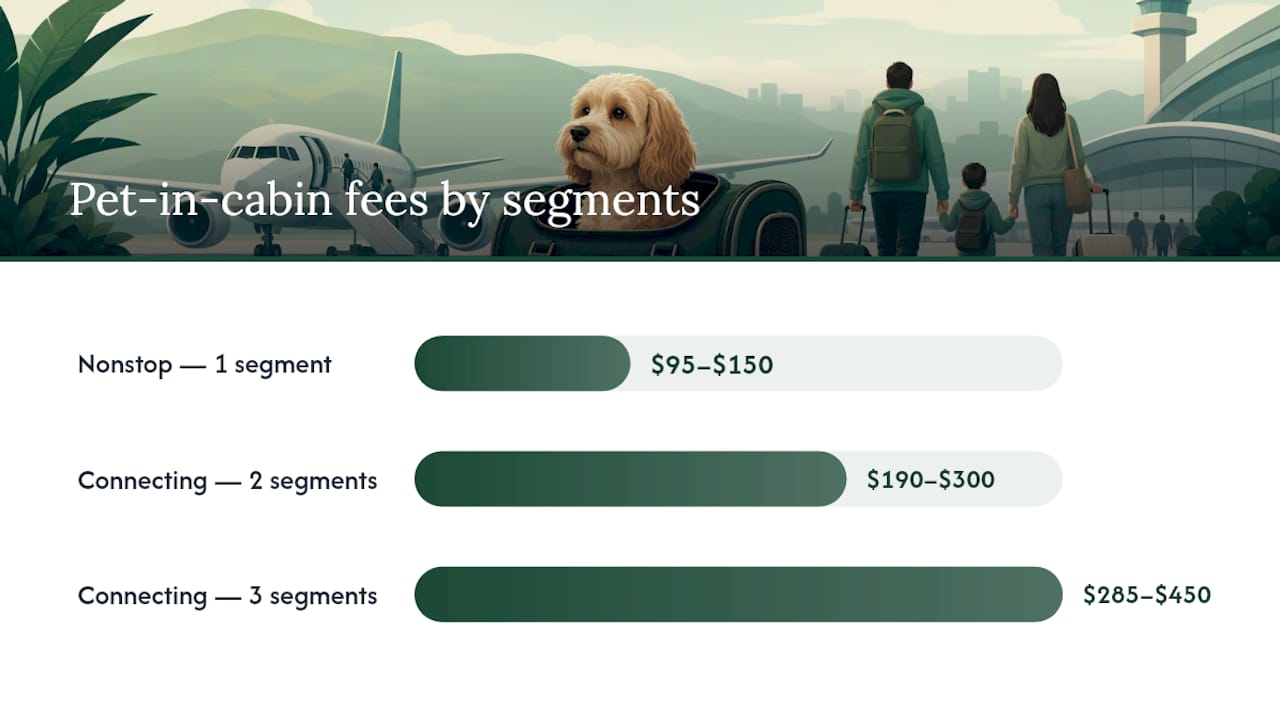
Pro Tip: Search for nonstop routes before you book. A single layover can add another full pet fee onto your total, sometimes more than $100 extra for a trip that already cost you the fee once.
Beyond cost, the operational rules get specific fast:
- Under-seat carriers generally need to stay within airline-published dimensions, usually somewhere around 18 x 11 x 11 inches, though this varies by carrier
- Most airlines require a soft-sided carrier that fits fully under the seat in front of you
- Cabins cap the number of pets allowed, so booking early matters more than people expect
- Staff will check vaccination paperwork and carrier fit at the gate, not just at check-in
- An animal that growls, barks persistently, or won’t stay contained can get you denied boarding on the spot
None of this is arbitrary. It’s the same framework every pet owner deals with. Your ESA just joined that pool.
Service Animals vs. ESAs: The Psychiatric Service Dog Path
Task training is the dividing line, and it’s a real one. A psychiatric service dog trained to interrupt a panic attack, retrieve medication, or perform deep pressure therapy during a dissociative episode qualifies as a service animal. An ESA that simply provides comfort by being present does not, regardless of how much that comfort matters clinically.
Here’s how the process works in practice:
- Confirm the dog performs a specific, trained task, not just companionship, tied to your disability
- Complete the DOT Service Animal Air Transportation Form, attesting to the dog’s training, health, and behavior, required by most U.S. carriers
- Submit the form within the airline’s window, generally 48 to 72 hours before departure, every single trip
- Expect operational limits to still apply, including harness requirements, behavior standards, and caps on how many service animals one passenger can bring
Qualifying doesn’t mean the paperwork disappears. It means you file it under a different set of rights.
International Travel: Check Import Rules Before You Book
There’s no unified global standard for flying with an ESA or a service animal, and that gap causes more denied trips than airline policy does. Each destination country sets its own import requirements, and airlines are obligated to enforce them at check-in, not sort them out for you.
Before you book anything international:
- Contact the destination country’s agriculture or health authority 10 to 30 days ahead, sometimes earlier for stricter destinations
- Ask specifically about rabies documentation timelines, since many countries require blood titer tests weeks in advance
- Confirm whether a permit or import license is required, which some countries mandate separately from airline approval
- Understand that if the destination blocks entry, you’re facing denied boarding, quarantine, or a costly return flight, not a simple rebooking
Destinations like Hawaii and several EU countries are notorious for paperwork that takes far longer than the flight itself to sort out.
Flying Your ESA as a Pet: A Step-by-Step Checklist
If you’re not pursuing service animal status, here’s the sequence that actually keeps a trip on track.
- Book the pet slot when you reserve your seat. Cabins fill up fast, and airlines cap how many pets they’ll allow per flight.
- Measure your carrier against the airline’s published specs, not a general estimate. Every airline’s under-seat dimensions differ slightly.
- Gather vaccination records and microchip information before travel day, not the morning of.
- Budget for the pet fee per segment, and check whether your airline requires payment online in advance or allows it at the gate.
- Arrive early on travel day and keep the carrier easily accessible for inspection.
- Have documents ready to show, even if the airline doesn’t flag you for a check. Gate agents move faster when you’re prepared.
- If you’re refused boarding, ask for a Complaints Resolution Official. Every U.S. carrier has one on staff, and DOT requires access to a CRO for disability-related disputes.
Pro Tip: Take a photo or note the time, gate, and agent’s name if a dispute happens. A documented interaction is far more useful in a complaint than a memory of what someone said.
Turning an ESA Into a Psychiatric Service Dog: What It Actually Takes
Upgrading isn’t a form you fill out once and forget. It’s a training commitment, and it only makes sense for people who fly often enough to justify it.
- Task training has to produce a reliable, repeatable behavior tied directly to a disability, and owner-trained dogs can qualify if the training holds up under real conditions
- Keep records of training milestones and any professional trainer involvement, since airlines can ask questions at the gate
- File the DOT Service Animal Air Transportation Form every trip, not once for life
- Expect the process to take months, not days, if you’re starting from a dog with no task training
For occasional flyers, the pet path with its fees is usually simpler. For frequent flyers whose mental health condition benefits from a trained task, the investment often pays off in avoided fees and guaranteed cabin access.
Scams to Avoid: What Doesn’t Work for Air Travel Anymore
Online “ESA registration” services, certificate kits, and ID card marketplaces do not grant any air travel rights, and haven’t since the 2021 rule took effect. Airlines are not required to recognize these documents, and most simply won’t.
Here’s what still matters and what doesn’t:
- A licensed clinician’s letter still carries weight for housing accommodations under the Fair Housing Act, but it does nothing at an airline check-in counter
- A paid “certification” or laminated ID card from a website is not recognized by any airline as service animal proof
- The only document with airline-recognized weight is the DOT Service Animal Air Transportation Form, paired with genuine task-training evidence
- If a site promises your pet “flies free forever” after a one-time purchase, that’s a sign to walk away
Housing paperwork and travel paperwork solve two different problems. Confusing them is exactly what scam sites count on.
An Editorial Take on Where This Rule Actually Lands
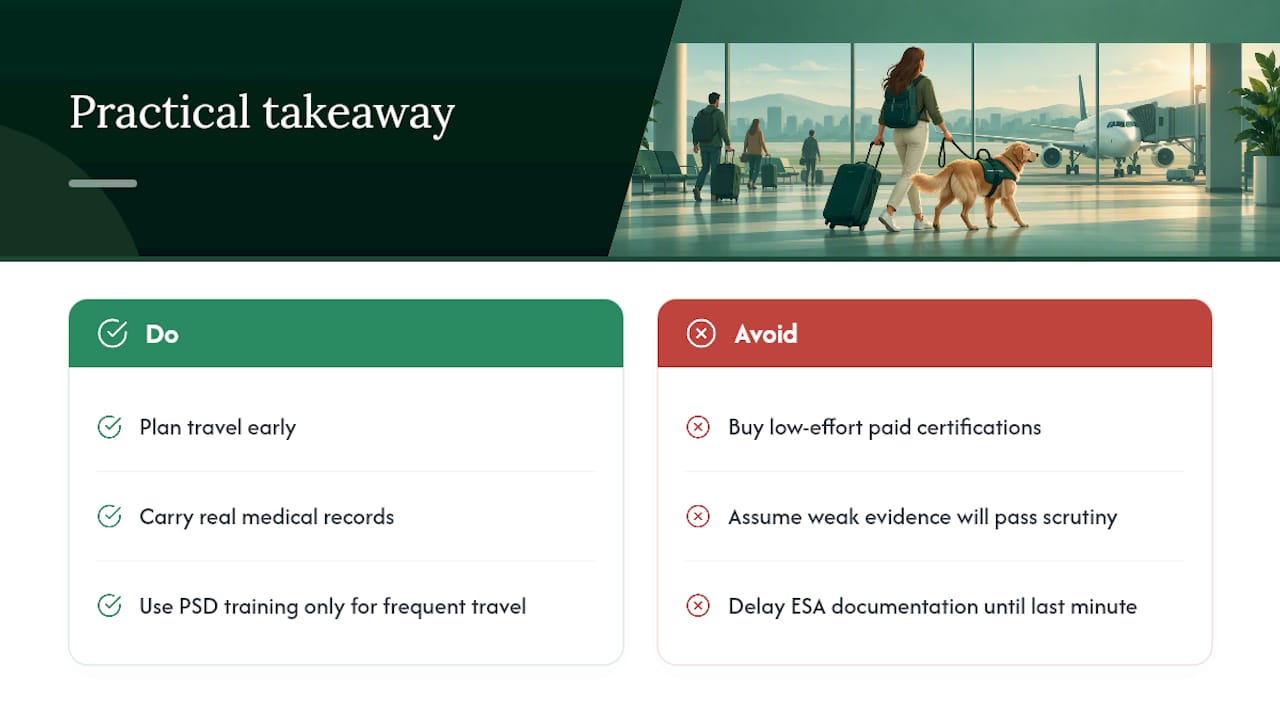
The 2021 rule gets criticized as a loss for people with mental health conditions, and in one sense it is. But the harder truth is that the ESA registration industry made that criticism easier to dismiss. Years of low-effort paid “certifications” gave regulators an easy target and made it simple to lump legitimate ESA owners in with people gaming the system for a free pet seat.
The honest path forward is clarity about current rules. Plan early, carry real records, and consider psychiatric service dog training only if frequent travel justifies the effort.
— Erik
Where to Get Help With the Paperwork That Actually Matters
Airline rules changed, but housing rights didn’t, and that’s where most ESA owners still need real guidance. This resource is built specifically to separate what’s legally solid from what’s a scam, without selling certificates that lack recognition at airline check-in.
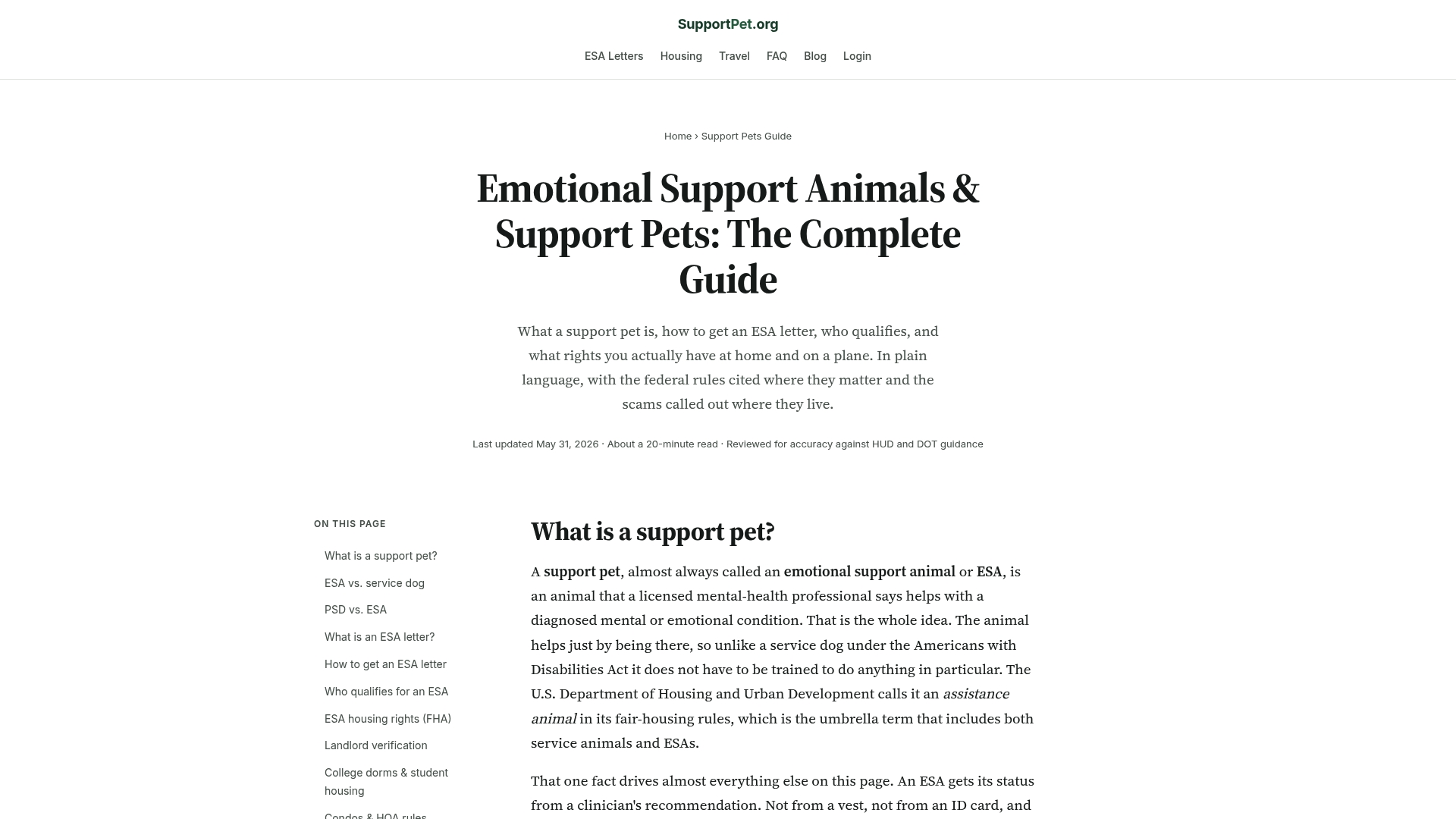
The Emotional Support Animals & ESA Letters guide walks through how to secure a legitimate ESA letter from a licensed clinician, how Fair Housing Act protections actually work for renters, and how to spot the registration schemes that cost money and deliver nothing. It also breaks down the difference between housing documentation and the DOT paperwork required for service animal travel, so you’re not caught applying the wrong document to the wrong situation. If you’re a renter trying to secure housing accommodations, or a pet owner deciding whether task training makes sense for your travel needs, start with the guide at Supportpet and get the paperwork right the first time.
Sources
Confirm current requirements directly: the DOT service animal resource verifies the current federal definition, the CDC import guidance covers destination-specific entry rules, and IATA’s service dog guidance explains industry best practices airlines are adopting.
This article is general information, not a substitute for advice from a qualified doctor. Consult a qualified healthcare professional about your own circumstances before acting on anything here.
- Service animals | U.S. Department of Transportation
- Traveling with pets and service animals | CDC Yellow Book guidance
FAQ
How Do I Bring an ESA on a Plane?
You book your ESA as a pet, since DOT no longer classifies ESAs as service animals. That means reserving a pet slot, meeting carrier size requirements, and paying the standard pet fee for your airline.
Do I Have to Pay for My ESA to Fly?
Yes, in almost every case. ESAs travel under standard pet policies now, with fees typically running $95 to $150 per flight segment, and some airlines still choose to offer discretionary ESA accommodations at no charge, though that’s a carrier decision, not a federal requirement.
Can My Dog Fly With Me as Emotional Support?
Your dog can fly with you, but not with the free cabin access and fee waivers ESAs used to get. It flies under the same pet rules as any other cabin pet unless it’s individually trained to perform a specific task, which would qualify it as a psychiatric service dog instead.
Can I Bring My ESA on American Airlines?
Yes, as a pet, following American’s standard pet-in-cabin policy, carrier size limits, and fee structure. Contact the airline directly before booking, since carriers occasionally adjust pet policies and it’s worth confirming current fees and carrier specs for your specific route.
What’s the Difference Between an ESA Letter for Housing and Airline Documentation?
An ESA letter from a licensed clinician supports housing accommodations under the Fair Housing Act and has no bearing on air travel. Airlines only recognize the DOT Service Animal Air Transportation Form, and only for dogs that meet the task-trained service animal definition.