
The Fair Housing Act still protects emotional support animals as a matter of statute. What changed on May 22, 2026 is enforcement, not the law itself. HUD now instructs its investigators to pursue reasonable cause findings mainly for animals trained to perform disability-related tasks, leaving untrained ESA claims with less federal muscle behind them. Practically, that pushes more disputes toward private lawsuits, state fair housing agencies, and tenants who can document their case well enough to negotiate without a federal investigation backing them up.
TL;DR:
- Federal enforcement now prioritizes trained animals for disability tasks, reducing the likelihood of HUD pursuing cases involving untrained emotional support animals.
- Landlords can still deny ESA requests if they prove undue burden, direct threat, or lack of necessary nexus, but cannot deny solely because the animal isn’t trained or the condition is mental health related.
- No federal registry or official certification for ESAs exists, so scammy letters from online sites have little legal weight compared to evaluations from licensed mental health professionals.
- State fair housing laws may offer stronger protections than federal enforcement, especially if HUD declines to investigate untrained ESA denial complaints.
- The key to a successful ESA request is a credible, well-documented letter from a licensed clinician demonstrating the animal alleviates specific disability symptoms linked to housing needs.
Table of Contents
- What Does the Fair Housing Act Require for ESA Accommodations?
- What Does HUD’s May 22, 2026 Memo Actually Say?
- How Do the FHA, ADA, and Section 504 Divide Up Housing and Public Spaces?
- How Do You Make an ESA Accommodation Request That Holds Up?
- Do State Laws Give ESA Owners More Protection Than Federal Law?
- How Can You Tell a Real ESA Letter From a Scam?
- The Real Cost of HUD’s Enforcement Shift Falls on Tenants Who Can’t Afford a Lawyer
- Where Supportpet Fits Into Preparing Your ESA Documentation
- Sources
- FAQ
What Does the Fair Housing Act Require for ESA Accommodations?
The FHA requires housing providers to make reasonable accommodations for tenants with disabilities, including waiving no-pet policies for assistance animals. That obligation comes from a standard baked into the statute itself: accommodation is required when it’s necessary to afford a person with a disability equal opportunity to use and enjoy a dwelling. Courts and HUD have applied this to emotional support animals for years, treating them as a category distinct from pets, not because the animal performs a task, but because it mitigates the effects of a diagnosed condition.
This is where a lot of confusion starts. The ADA has a clean, bright-line test for service animals. The FHA does not. Nowhere in the statutory text does the Fair Housing Act require an assistance animal to be trained to perform a specific task. The law asks a different question: does the person have a disability, and does the animal help alleviate the symptoms of that disability in a way tied to the home? That’s the nexus test, and it’s been the backbone of ESA housing law since before HUD ever issued formal guidance on the subject.
A landlord can still deny a request, but only on specific grounds. The three that come up most often:
- Undue burden. The accommodation would impose an unreasonable financial or administrative burden on the housing provider, given its size and resources.
- Direct threat. The animal poses a demonstrated threat to health or safety that can’t be eliminated or reduced through another reasonable accommodation.
- No nexus. The tenant hasn’t shown a connection between the disability and the need for the animal, meaning the request doesn’t meet the “necessary” prong of the standard.
What a landlord generally cannot do is deny a request just because the animal wasn’t trained, or because the condition is a mental health diagnosis rather than a physical one. That distinction between task training and emotional support is exactly where HUD’s 2026 memo has shifted the ground, at least on the enforcement side. The statute hasn’t moved. The reasonable accommodation analysis HUD and courts have long applied to weigh necessity, reasonableness, and undue burden case by case remains intact in the law itself.
One more wrinkle worth knowing: the FHA’s protections apply regardless of breed, size, or species restrictions that would otherwise be lawful under a building’s pet policy. A no-dogs building generally still has to accommodate a dog serving as an ESA if the tenant meets the disability and necessity showing. Weight limits, breed bans, and pet deposits written into a standard lease don’t automatically override a valid accommodation request. They just don’t guarantee that request will be enforced the same way it might have been investigated two years ago.
What Does HUD’s May 22, 2026 Memo Actually Say?
HUD’s new enforcement guidance tells Fair Housing and Equal Opportunity (FHEO) staff to prioritize investigations involving animals individually trained to perform disability-related work or tasks. For complaints involving untrained emotional support animals, the memo instructs investigators to generally decline to find reasonable cause. That’s a sharp break from the agency’s prior posture.
It also formally rescinds HUD’s earlier notices, including the widely cited FHEO-2013-01 and FHEO-2020-01, both of which told housing providers that assistance animals, including ESAs, are not pets and shouldn’t be charged pet fees or deposits. Those notices had shaped a decade of housing practice. Their rescission doesn’t erase the FHA’s accommodation requirement, but it strips away the specific administrative interpretation landlords and tenants had both been relying on.
Open cases already in the pipeline are being held for review under the new standard, meaning tenants with pending HUD complaints involving untrained ESAs may see those cases reassessed or closed without a reasonable cause finding.
It helps to be precise about what actually shifted here. This is an administrative enforcement change, not a statutory one. Congress didn’t amend the Fair Housing Act, and no court struck down the ESA accommodation standard. HUD, as the agency responsible for administrative enforcement, redirected its own investigative priorities. Legal analysts note that the memo effectively aligns HUD’s investigative posture with the ADA’s trained-animal standard for enforcement purposes, even though the FHA’s underlying legal text still doesn’t require training.
The practical fallout is already visible in three places. First, landlords are more likely to charge pet fees or deposits for ESAs now that the guidance discouraging those fees has been withdrawn, even though a strong legal argument against those fees can still be made under the statute itself. Second, tenants filing a fresh HUD complaint over an untrained ESA denial should expect a lower chance of a federal reasonable cause finding than they would have a year ago. Third, and this is the part advocates are flagging hardest: enforcement discretion narrowing at the federal level pushes the real fight toward private litigation, which costs money and time that not every tenant has.
How Do the FHA, ADA, and Section 504 Divide Up Housing and Public Spaces?
Three different federal laws touch assistance animals, and mixing them up is the single most common mistake renters make. Each governs a different setting, with a different legal test.
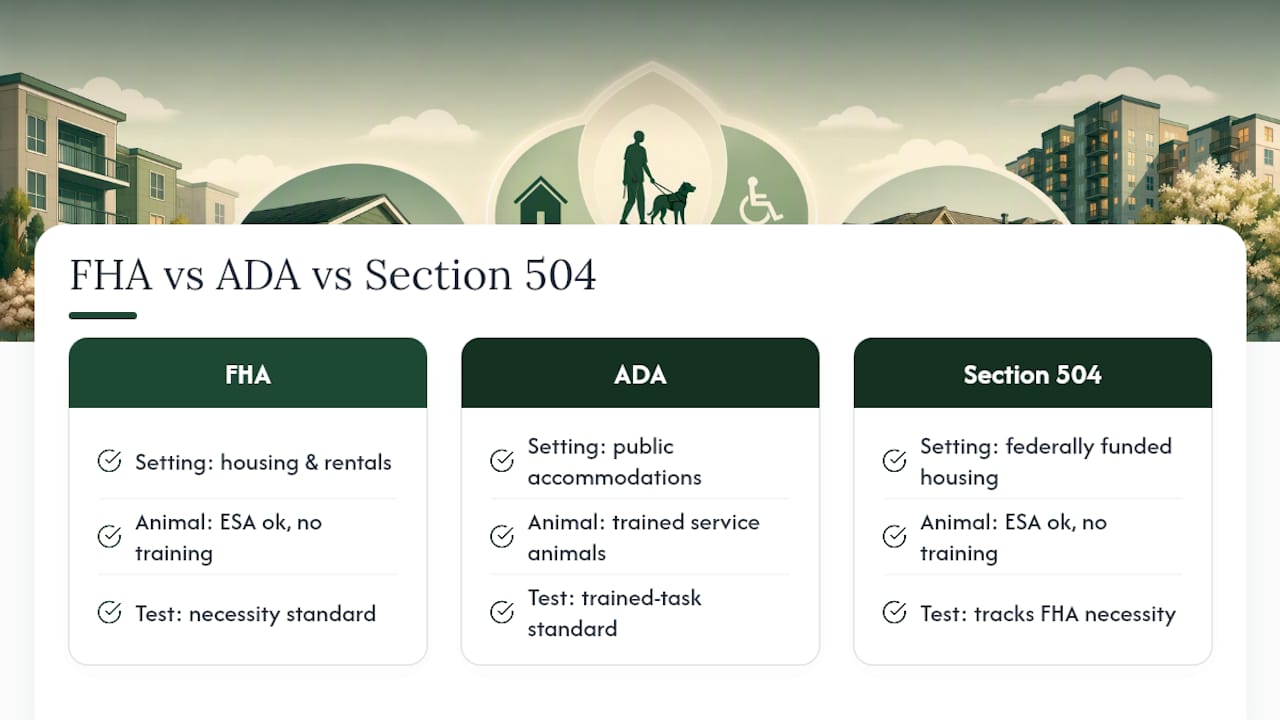
The ADA covers public accommodations: restaurants, stores, hotels, transit, and other places open to the public. Under the ADA’s service animal definition, only dogs (and in limited cases miniature horses) individually trained to perform a specific task related to a disability qualify. Emotional support and comfort alone, without a trained task, does not meet the ADA standard. This is why an ESA can be denied entry to a restaurant even while it’s fully protected in the tenant’s own apartment.
The FHA covers housing, private rentals, condos, co-ops, and most residential leasing. As covered above, it uses a broader disability-related necessity standard that doesn’t require training. This is the law that actually governs whether your landlord has to let your ESA live with you.
Section 504 of the Rehabilitation Act covers programs and housing that receive federal financial assistance, including public housing authorities, Section 8 voucher programs, and HUD-funded developments. Section 504 has historically tracked the FHA’s disability-related accommodation standard rather than the ADA’s stricter task-training test, and nothing in HUD’s 2026 enforcement memo rewrites Section 504’s own text. If you live in a federally funded building, that statute still gives you an independent legal footing beyond whatever HUD’s FHA enforcement priorities happen to be this year.
The quick sorting question: are you trying to get into a business, or trying to keep an animal in your home? Business or public space, look to the ADA’s trained-task standard. Your home, condo, or federally assisted housing, look to the FHA and Section 504’s necessity standard, both of which remain unchanged as statutes regardless of HUD’s enforcement priorities.
How Do You Make an ESA Accommodation Request That Holds Up?
A credible accommodation request is built, not improvised. Here’s the sequence that gives you the strongest position if a landlord pushes back or a dispute ends up in front of a state agency or a court.
- Get a legitimate clinician recommendation first. It needs to come from a licensed mental health professional who has actually evaluated you, not a website that issues a letter after a five-minute quiz.
- Put the request in writing. Email or a dated letter, not a verbal conversation, and keep a copy of everything you send.
- State the disability-related need plainly. You don’t have to disclose your diagnosis, but the letter should establish that you have a condition that substantially limits a major life activity and that the animal helps.
- Attach the clinician’s letter and deliver it through a verifiable channel. Certified mail, dated email, or a portal that logs receipt.
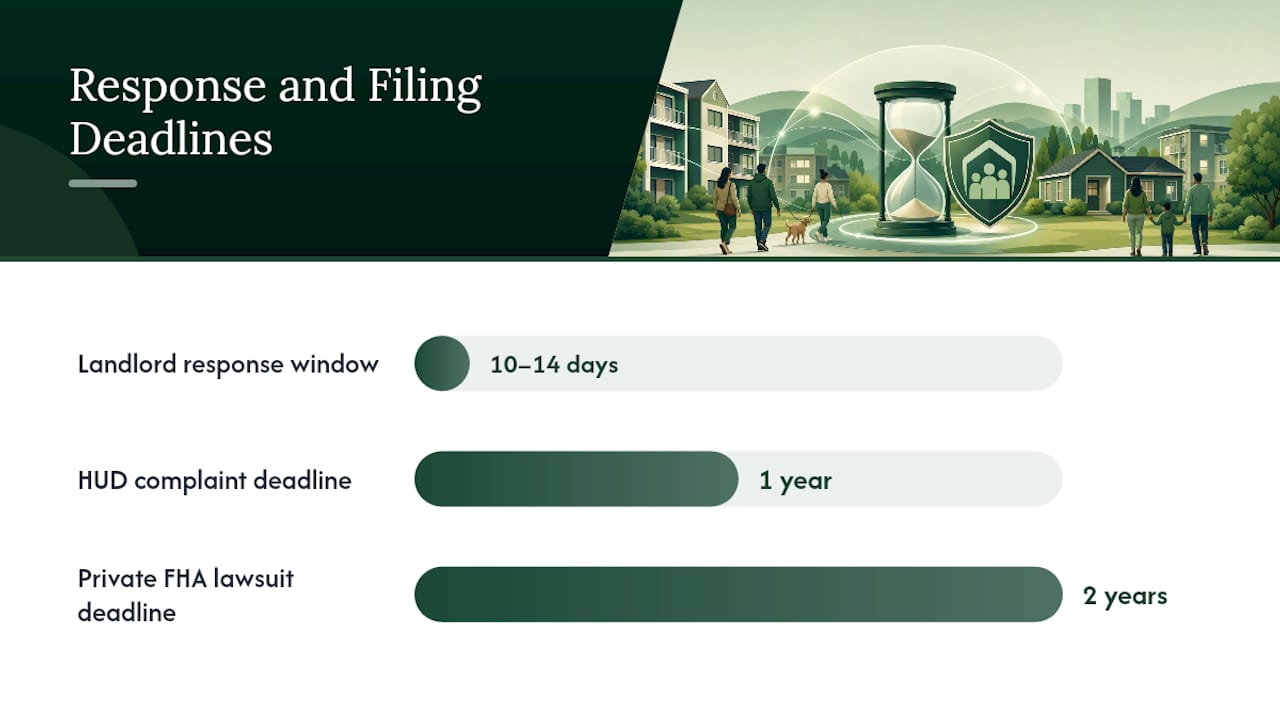
- Give the landlord a reasonable window to respond, typically ten to fourteen days is standard practice, before you follow up in writing.
- If denied, ask for the specific reason in writing. A vague “no pets” response isn’t a lawful denial under the FHA; a landlord has to engage with the accommodation request on its merits.
- Escalate deliberately if the denial doesn’t hold up: a HUD complaint, your state fair housing agency, or private counsel, roughly in that order depending on urgency and resources.
Landlords may ask you to confirm you have a disability and that the animal is necessary because of it. They generally cannot demand your specific diagnosis, insist the animal complete a training program, or charge a pet deposit or monthly pet fee for a documented ESA. They also cannot demand a specific registry certificate, since no such federal registry exists in the first place.
Statutes of limitations vary. HUD administrative complaints typically must be filed within one year of the discriminatory act, while private FHA lawsuits generally allow up to two years, though state law can shorten or extend either window. Don’t sit on a denial. The clock starts running the day the accommodation is refused, not the day you finally decide to do something about it.
Pro Tip: Keep a simple paper trail folder, physical or digital, with the clinician’s letter, every email to the landlord, and dated notes of phone calls. If a dispute drags on for months, that folder is the difference between a credible case and a frustrating he-said-she-said.
Do State Laws Give ESA Owners More Protection Than Federal Law?
HUD’s 2026 memo only governs how HUD itself investigates federal complaints. It has no power to rewrite state fair housing statutes, and several states have accommodation standards that are more protective than the current federal enforcement posture, with their own agencies willing to investigate ESA denials HUD might now decline to pursue.
If you live in federally subsidized housing, Section 504 obligations for that program generally continue to apply on their own legal footing, separate from HUD’s FHA enforcement priorities. Before assuming you’re out of options, check your state’s fair housing statute and look up your state or local fair housing agency. Many operate independently of HUD, run their own complaint intake, and haven’t adopted anything resembling the federal enforcement change. A denial that HUD might decline to pursue this year could still be a straightforward violation under your state’s own law.
How Can You Tell a Real ESA Letter From a Scam?
The ESA letter industry has a scam problem, and HUD’s enforcement shift makes clean documentation matter more, not less. A weak or fraudulent letter used to get some benefit of the doubt from federal investigators. Under the current guidance, it’s far more likely to get a denial that sticks.
Red flags that should stop you before you pay for anything:
- Instant approval after a short online quiz, with no live conversation with a clinician.
- A “certificate,” “registration number,” or ID card, since no federal ESA registry exists and none of these carry legal weight.
- No follow-up contact, no phone or video session, and no way to reach the person who supposedly evaluated you.
- Pressure to buy a vest, ID badge, or “official” gear bundled with the letter.
A legitimate ESA recommendation comes from a licensed mental health professional (a therapist, psychologist, psychiatrist, or licensed clinical social worker) who has had real clinical contact with you. The letter should be on the clinician’s letterhead, include their license number and jurisdiction, and state the nexus directly: that you have a diagnosed condition and that the animal helps alleviate specific symptoms tied to it. That last piece, the nexus statement, is the part landlords and courts actually scrutinize.
Practitioners in this field consistently point to one detail: a letter that shows genuine clinical contact and spells out how the animal helps with specific symptoms carries far more weight in a dispute than one relying on a registry number or a sales certificate. Keep the original letter, the clinician’s contact information, and any renewal correspondence in one place. If your landlord disputes the letter’s legitimacy, a licensed mental health professional or a legal aid organization is a better next call than another online letter service.
Pro Tip: If a website sells the letter before you’ve spoken to anyone with a license, that’s not a shortcut. That’s the scam.
The Real Cost of HUD’s Enforcement Shift Falls on Tenants Who Can’t Afford a Lawyer
HUD backing away from untrained ESA cases doesn’t change what the law says. It changes who has to enforce it. A tenant with a documented disability and a legitimate clinician’s letter is still legally entitled to that accommodation under the FHA. What’s different is that fewer of those tenants will have a federal investigator doing the legwork for them, which means more people are going to have to negotiate directly, escalate to a state agency, or find a lawyer willing to take the case.
That burden lands hardest on renters who can least afford a private lawsuit, exactly the group ESAs are meant to help in the first place. My honest read: the smart move now is treating documentation as a legal shield, not paperwork, and knowing your state fair housing agency’s number before you ever need to dial it. Local disability-rights organizations and legal aid clinics are worth contacting even before a dispute starts, not just after.
— Erik
Where Supportpet Fits Into Preparing Your ESA Documentation
This resource offers guidance to help renters understand what a legitimate ESA letter needs to contain, how to connect with a licensed clinician who provides real evaluation, and how to build a documentation packet that holds up if a landlord pushes back.
If you’re preparing a reasonable accommodation request right now, use the Emotional Support Animals & ESA Letters guide to understand what documentation actually carries weight versus what’s just a registry gimmick. The guides walk through the clinician evaluation process, what belongs in a nexus statement, and the specific scam patterns to avoid before you spend money on anything. This is educational information to help you prepare, not legal representation, so pair it with a state fair housing agency or an attorney if your case escalates. Start by reading through the ESA letter and housing rights guide before you send your next request to a landlord.
This article is general information, not a substitute for advice from a qualified lawyer. Consult a qualified legal professional about your own circumstances before acting on anything here.
Sources
- Enforcement Guidance – Assessing Requests for the Use of an Animal as a Reasonable Accommodation Under the Fair Housing Act (May 22, 2026) — HUD
- Assistance animals under the Fair Housing Act (FHEO-2013-01) — HUD archive
- An Enforcement Agency That Won’t Enforce: HUD’s Policy Reversal On Emotional Support Animals — DREDF
- Ada
FAQ
What Are the New Federal Rules on Emotional Support Animals?
HUD’s May 22, 2026 memo directs investigators to prioritize reasonable cause findings for animals trained to perform disability-related tasks and to generally decline to find reasonable cause for untrained ESAs, though the FHA’s underlying accommodation requirement hasn’t changed.
Can a Landlord Legally Deny an Emotional Support Animal?
Yes, but only on specific grounds: undue financial or administrative burden, a documented direct threat to safety, or a failure to show a nexus between the disability and the need for the animal. A denial based solely on lack of training generally does not meet the FHA standard, even though HUD may now be less likely to investigate that denial.
What Are the New Rules for Emotional Support Animals in 2026?
The core rule is the same as before: the FHA still requires reasonable accommodations for ESAs when necessity is shown. What changed is that HUD will generally not pursue federal enforcement action for untrained ESA denials, shifting the practical burden toward state agencies and private lawsuits.
When Can a Landlord Legally Reject an ESA in Florida?
Florida follows the federal FHA framework alongside its own state-level assistance animal statute, so a landlord can reject a request there on the same undue burden, direct threat, or no-nexus grounds recognized federally, with Florida’s Fair Housing Act enforcement providing an additional avenue tenants can use regardless of HUD’s current enforcement posture.
Does HUD’s 2026 Memo Mean ESAs Are No Longer Protected?
No. The memo changes how HUD enforces the law administratively; it does not repeal or amend the Fair Housing Act itself, and tenants can still pursue private litigation or state agency complaints for a denied ESA accommodation.