
Yes, an emotional support animal can help some people with autism manage anxiety, sensory overload, and rough transitions, but it is not a service animal and carries no automatic housing guarantee. The real first step is a licensed clinician evaluation that results in a valid ESA letter. With HUD’s 2025 to 2026 guidance now weighing documentation more heavily, getting that letter right matters more than it used to.
TL;DR:
- Getting a valid ESA letter requires a licensed mental health professional who conducts an in-depth assessment rather than a quick online form.
- Landlords cannot demand full diagnosis details or pet deposits for a documented ESA but can ask for current documentation from a qualified provider.
- New HUD guidance emphasizes individualized review of ESA requests, making generic or vague letters more likely to be rejected or scrutinized.
- Breed and species choice should match the autistic person’s sensory sensitivities and household routine rather than popular stereotypes.
- Scam ESA websites offering instant approvals and registry certificates usually produce invalid documents, so verification of clinician credentials is essential.
Table of Contents
- What Is an ESA for Autism, and How Is It Different From a Service Animal?
- How to Get a Legally Valid ESA Letter for Autism
- Housing Rights, HUD Guidance, and What Landlords Can Actually Ask
- Choosing and Caring for an ESA When You or Your Child Is Autistic
- How to Spot a Fake ESA Letter Before It Costs You Money
- A Clinician-Anchored View of ESAs and Autism
- Get Your ESA Documentation Right the First Time With Supportpet
- Sources
- FAQ
What Is an ESA for Autism, and How Is It Different From a Service Animal?
An emotional support animal provides comfort through its presence. It requires no specialized training, and its entire job is to be there. A service animal is a different legal category altogether: under the ADA, a service dog must be individually trained to perform a specific task tied to a disability, like interrupting a repetitive behavior or applying deep pressure during sensory overload. That training requirement is exactly what an autism support animal in the ESA category skips.
For many autistic people, that lack of task training is not a downside. A calm dog or cat sitting nearby during a school transition, a loud gathering, or a change in routine can lower stress without needing a single trained command. ADA guidance and accessibility resources agree that ESAs are not service animals, so they do not carry the same right to enter restaurants, stores, or workplaces.
Species and use cases vary by household and by clinician recommendation:
- Dogs and cats are the most common choices, often selected for calm, predictable temperaments.
- Rabbits and small caged animals sometimes work well for sensory sensitivities to fur, noise, or size.
- Birds appeal to some autistic individuals who respond to rhythm and repetition in sound.
Public access stays limited to housing and, in some cases, air travel. Everywhere else, an ESA is treated like any other pet.
How to Get a Legally Valid ESA Letter for Autism
Getting a letter that actually holds up starts with the right professional, not a website that promises same-day approval.
A licensed mental health professional (LMHP) has to write it. That includes licensed clinical social workers, psychologists, licensed professional counselors, and psychiatrists. Check that the license is active and issued in the state where the clinician practices, and that it covers the diagnosis being discussed.
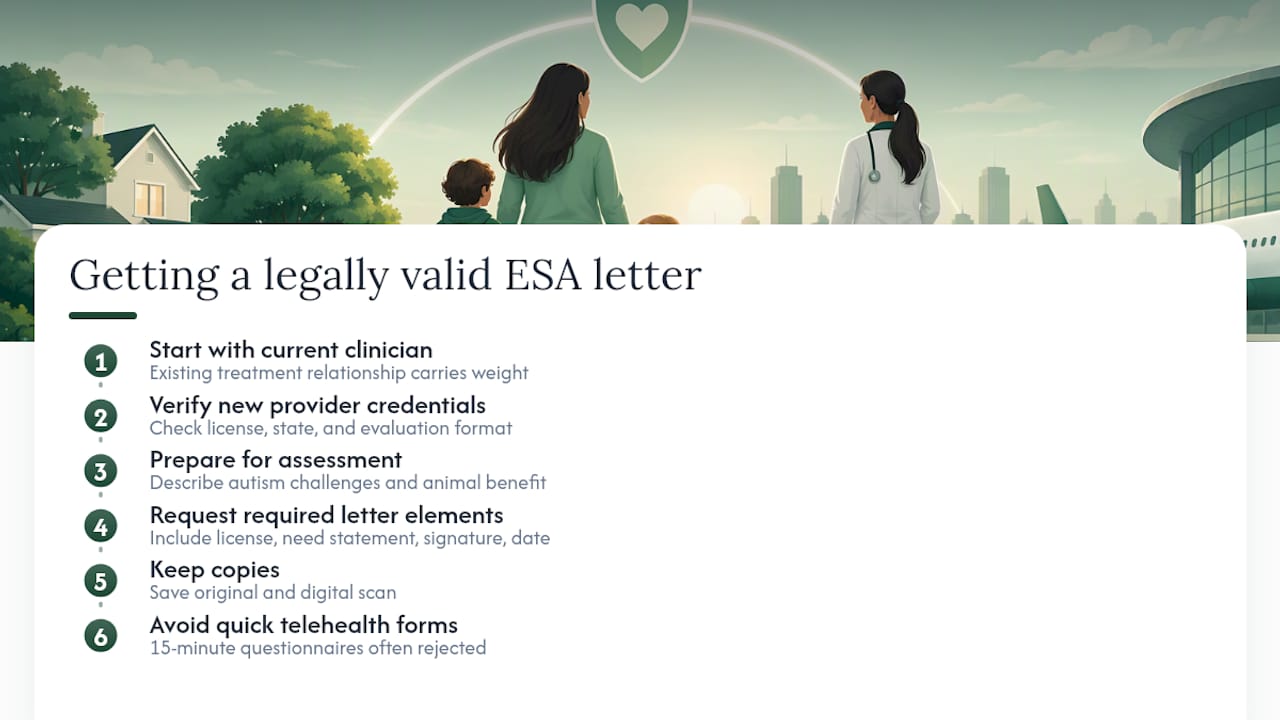
Step 1: Talk to your current clinician first. If your autistic child or you already see a therapist or psychiatrist, start there. An existing treatment relationship carries more weight with landlords than a one-off evaluation from a stranger.
Step 2: If you need a new provider, verify credentials before booking. Look up the license number, confirm the clinician offers a real evaluation (live video or in person), and avoid any service that skips a conversation entirely.
Step 3: Prepare for the assessment. Be ready to describe specific autism-related challenges, sensory triggers, or anxiety patterns, and how an animal’s presence helps manage them. Vague answers produce vague letters.
Step 4: Request the required elements in writing. A valid letter needs the clinician’s license information, a statement of disability related need, and a signature, and it should be reasonably current for most housing providers to accept it without question.
Step 5: Keep copies. Save the original and a digital scan. You will likely need it again for lease renewals or moves.
Pro Tip: A letter built on a single 15-minute telehealth questionnaire is far weaker than one from a clinician who has actually treated you. Evaluations that rely only on automated forms are frequently rejected once a landlord pushes back.
Housing Rights, HUD Guidance, and What Landlords Can Actually Ask
The Fair Housing Act requires landlords to make reasonable accommodations for assistance animals, even in buildings with strict no-pet policies. That has not changed. What changed is how hard landlords lean into scrutiny before approving an ESA request.
HUD issued new enforcement guidance on May 22, 2026, shifting the presumption of reasonable cause toward trained assistance animals and requiring more individualized review for untrained ESAs. In practice, that means a generic letter with no specifics about the applicant’s autism symptoms is more likely to draw a follow-up request than it was a couple of years ago.
Landlords still cannot demand a full diagnosis, charge a pet deposit or monthly pet rent for a documented ESA, or accept an online registry certificate as proof of anything. Registries have no legal standing regardless of what their marketing claims.
What landlords can legally do:
- Ask for documentation from a licensed provider confirming a disability related need.
- Request that the letter be reasonably current, generally within the past year.
- Deny a request if the specific animal poses a direct threat or would cause substantial property damage.
If a request gets denied, ask for the denial in writing and the specific reason. Vague or blanket denials without individualized assessment may violate the Fair Housing Act, and HUD’s own enforcement guidance now asks housing providers to document their reasoning case by case rather than issue automatic refusals.
Choosing and Caring for an ESA When You or Your Child Is Autistic
The right animal for an autism support animal role depends less on breed reputation and more on fit. A high-energy dog that needs constant engagement can add stress rather than reduce it for a household that already manages sensory overload. A quiet, predictable cat or a calm senior dog often works better than a puppy that demands training time nobody has.
Match the animal to the household’s actual routine, not an idealized one:
- Consider noise sensitivity: some autistic individuals do better with quiet animals like rabbits or older, low-bark dogs.
- Plan for consistent feeding, grooming, and vet visits, and identify a backup caregiver for days when routine breaks down.
- Basic housebreaking and manners matter even without task training. A disruptive animal creates friction with neighbors and can undermine an otherwise valid housing request.
Pro Tip: Introduce a new ESA gradually, using the same visual schedules or transition supports that already work at home. A sudden new presence in the house is itself a routine change, and routine changes are exactly what tend to spike anxiety in autistic individuals.
How to Spot a Fake ESA Letter Before It Costs You Money
Scam ESA sites are easy to spot once you know the pattern, and they cost real money for a document landlords will likely reject.
- Red flag: instant approval. Any site promising a letter in minutes without a real conversation with a clinician is not producing a defensible document.
- Red flag: registry certificates and ID cards. These have no legal weight anywhere. No law requires or recognizes ESA registration.
- Verify the clinician independently. Search the license number through the state licensing board before paying anything.
- If you already paid for a questionable letter, get a second opinion from a genuinely licensed provider and keep every record. HUD’s FHEO office is the right place to report a suspected pattern of fraud affecting housing decisions.
A Clinician-Anchored View of ESAs and Autism
An ESA works best as one part of a treatment plan, not a replacement for one. The most consistent pattern in cases involving autism is a calmer bedtime routine, an easier morning transition, or a lower baseline anxiety level once the animal and the person settle into a shared rhythm together. That kind of change tends to show up gradually, and it tends to hold up better when a clinician is still involved after the letter gets signed.
Guidance leans hard on that point: the letter is a legal document, but the ongoing clinical relationship is what actually determines whether the animal helps.
— Erik
Get Your ESA Documentation Right the First Time With Supportpet
Every scam registry and instant-letter site out there sells speed. The site provides a plain-language breakdown of what a valid letter actually requires, so you spend your money on a real clinician instead of a worthless certificate.
Before you book a clinician appointment or submit a housing request, work through an ESA rights and letter guide to see exactly what documentation your landlord can and cannot demand under current HUD guidance. The guide breaks down letter requirements, common landlord objections, and how to respond if a request gets denied, all without promoting any registration services. If you are preparing for a conversation with a landlord or a clinician this month, start with the checklist so you walk in with the right paperwork the first time.
This article is general information, not a substitute for advice from a qualified doctor. Consult a qualified healthcare professional about your own circumstances before acting on anything here.
Sources
- Assessing requests for the use of an animal as a reasonable accommodation under the Fair Housing Act
- Service animals and emotional support animals (ADA guidance)
- ESA housing letter: what it is & how to get one
FAQ
Can an Autistic Person Legally Have an ESA?
Yes. Autism can qualify as a disability for ESA purposes when a licensed clinician determines the animal provides a disability related benefit, such as reduced anxiety during transitions. The letter, not the diagnosis alone, is what a landlord relies on.
Is an ESA the Same as an Autism Service Dog?
No. A service dog must be individually trained to perform a specific task tied to autism, like interrupting a meltdown behavior, while an ESA provides comfort with no training requirement and no ADA public access rights.
Can a Landlord Deny My ESA Request for Autism?
A landlord can deny a request only for specific, individualized reasons, such as the animal posing a direct threat, not because they dislike pets. Under HUD’s 2026 guidance, denials for untrained ESAs now require more individualized assessment rather than a blanket policy.
Can I Fly With My Autism ESA?
Not automatically. Most airlines now treat emotional support animals as regular pets for cabin travel purposes, subject to standard pet fees and carrier rules, unlike a trained service animal.
Does My Child’s School Have to Allow an ESA for Autism?
Not automatically. Schools evaluate assistance animal requests through Section 504 or an IEP team rather than housing law, and the team decides individually whether the animal is necessary for the student.