
An emotional support animal can genuinely ease depression symptoms for some people, but only when the animal addresses a documented functional impairment, not just a diagnosis on paper. Qualifying isn’t automatic. It requires a licensed clinician to assess how depression limits your daily life and to confirm an animal’s presence would help. If you’re wondering whether this applies to you, the first move isn’t researching breeds. It’s talking to your treating clinician, or arranging a legitimate evaluation with one.
TL;DR:
- A licensed clinician must assess how depression causes functional impairment and determine if an animal can plausibly help address specific symptoms like isolation or motivation.
- Evidence suggests ESAs can improve loneliness, encourage daily routines, and reduce stress, but current research is observational and does not confirm causation.
- Qualification requires documentation that details how the animal directly supports symptom management, not just a diagnosis of depression.
- Legitimate ESA letters originate from clinicians who evaluate you in person or via valid telehealth, and they must include specific certification details.
- Landlords must reasonably accommodate ESAs under the Fair Housing Act, but public access rights for ESAs are limited compared to service animals.
Table of Contents
- How an ESA for Depression Can Help: Mechanisms and Evidence
- Can Depression Qualify You for an ESA?
- Step-by-Step: Getting a Legitimate ESA Letter
- Legal Protections and Limits: Housing, Travel, and Public Access
- Choosing the Right Animal and Planning for Real Life
- Avoiding ESA Letter Scams and Instant-Approval Mills
- When Landlords or Skeptics Push Back on Your ESA
- A Practical Note on Getting Started
- How Supportpet Helps You Get a Legitimate ESA Letter
- Sources
How an ESA for Depression Can Help: Mechanisms and Evidence
Depression thins out your day. It strips away routine, shrinks your social world, and makes getting off the couch feel like a negotiation you keep losing. An emotional support animal interrupts that pattern through a few concrete channels rather than some vague “feel-good” effect.
Dogs need walks on a schedule, which forces behavioral activation, the same principle therapists use when they assign small daily tasks to rebuild momentum. Cats and smaller animals still demand feeding, litter changes, and attention, which anchors a routine even on days when nothing else does. Physical contact with an animal is linked to oxytocin release, and simply having another living presence in the room cuts down on the isolation that feeds depressive thinking.

The research backing this is encouraging but not settled. A longitudinal pilot study placing shelter animals with adults with serious mental illness found significant drops in self-reported depression, anxiety, and loneliness over 12 months. The study’s own authors flagged design limitations, small sample size and no control group among them, so treat this as a promising signal, not proof. Broader systematic reviews of human-animal interaction reach a similar conclusion: companion animals correlate with less loneliness and sometimes lower depressive symptoms, but most of that data is observational. Correlation, not causation.
What tends to improve most reliably:
- Day-to-day loneliness and the sense of having “someone” who needs you
- Motivation to leave bed or the house, even briefly
- Momentary stress spikes, the kind that hit hardest in the evening or on weekends
Reality check: an ESA supports your treatment plan. It doesn’t replace therapy or medication, and no credible clinician will tell you otherwise.
Can Depression Qualify You for an ESA?
Having a depression diagnosis alone doesn’t automatically qualify you for an emotional support animal. What matters is functional impairment, meaning depression has to interfere with major life activities in a way an animal would plausibly help address. NIMH describes core depressive symptoms as persistent low mood, reduced motivation, disrupted sleep or appetite, and difficulty concentrating. Those symptoms are the raw material a clinician works with when deciding whether an ESA fits your case.
Evaluators commonly weigh:
- Whether isolation has become a pattern, not an occasional bad week
- Loss of motivation severe enough to disrupt work, school, or basic self-care
- Sleep and appetite disruption tied directly to depressive episodes
- Whether an animal would plausibly counteract a specific symptom, like encouraging daily walks that combat withdrawal
Documentation carries more weight when it’s specific. A letter stating “patient has depression” does little. A letter noting that “the animal reduces isolation by prompting daily walks and consistent social contact” gives a landlord or housing authority something concrete to evaluate, and it reflects how clinicians are advised to frame functional impairment rather than leaning on diagnosis alone.
A few practical notes worth knowing before you start the process:
- Some states now require an existing provider relationship before a clinician can issue ESA documentation, closing the door on one-time online evaluations.
- Your case gets stronger when the clinician has actually treated you for a period of time, not met you once on a video call.
- Functional impairment has to be current, not something you experienced years ago.
Step-by-Step: Getting a Legitimate ESA Letter
Step 1: Start with your existing provider. If you’re already seeing a therapist, psychiatrist, or primary care doctor for depression, ask them directly whether an ESA letter fits your treatment. This route tends to move fastest because they already have your clinical history.
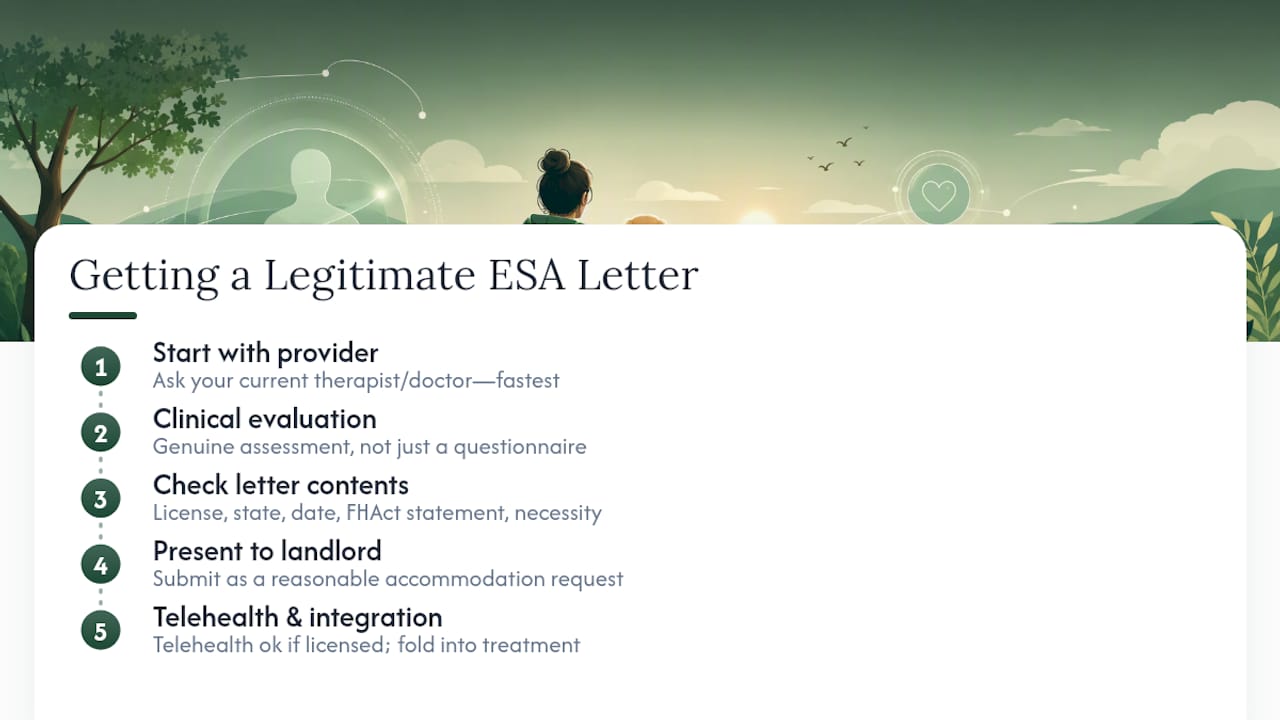
Step 2: Go through a real clinical evaluation. If you don’t have a provider, you need one who will actually assess you, not just collect a fee. That means discussing your symptoms, how they affect daily functioning, and whether an animal would help. This should feel like an appointment, not a checkout page.
Step 3: Confirm the letter contains what it needs to. A legitimate ESA letter includes the clinician’s license type and number, the state where they’re licensed, the date, confirmation you have a mental health condition covered under the Fair Housing Act, and a statement that the animal is necessary for your treatment or well-being. It should sit on official letterhead, not a template with a logo slapped on.
Step 4: Present it to your landlord or housing provider. Submit the letter as part of a formal reasonable accommodation request. Landlords can verify the letter’s authenticity and ask limited follow-up questions, but they can’t demand your full medical records.
Telehealth evaluations are legitimate when the clinician holds an active license in your state and conducts a genuine clinical assessment. What’s not legitimate is a five-minute questionnaire that spits out a letter regardless of your answers. Timelines vary, but a real evaluation typically takes one to a few sessions, and costs land closer to a standard therapy consultation fee than the inflated prices some letter mills charge.
Pro Tip: Ask your clinician to fold the ESA conversation into your regular treatment planning rather than treating it as a separate errand. A letter grounded in an ongoing care relationship holds up better under scrutiny than one requested cold.
For a full walkthrough of what a compliant letter looks like, Supportpet’s guide to ESA letters breaks down the requirements state by state.
Legal Protections and Limits: Housing, Travel, and Public Access
The Fair Housing Act is where ESA protections actually have teeth. HUD requires housing providers to make reasonable accommodations for assistance animals, including waiving no-pet policies and pet fees, when a resident documents a disability-related need. This applies even in buildings with strict pet bans.
Landlords can ask for documentation and, in some cases, verify it with the issuing clinician, but they can’t demand your diagnosis details or medical chart. They also can’t charge a pet deposit or monthly pet rent for a documented ESA, since it isn’t legally classified as a pet.
Where things get misunderstood is outside housing. The ADA draws a firm line between service animals, which are trained for specific tasks and carry public access rights into stores and restaurants, and ESAs, which don’t have that same access. Airlines tightened their rules significantly in recent years, and most now treat ESAs the same as regular pets, meaning fees and crate requirements apply just like they would for any dog or cat you bring aboard.
A few things to know before you submit a housing request:
- Bring the letter, not a verbal explanation, when you make your accommodation request in writing.
- Expect the process to take days to a couple of weeks depending on your housing provider.
- Public access (stores, restaurants, workplaces) isn’t guaranteed for ESAs the way it is for service dogs.
Choosing the Right Animal and Planning for Real Life
The right animal for depression is the one that matches your worst week, not your best one. Dogs offer strong routine and social benefits, forced walks, eye contact, a reason to get dressed, but they demand daily exercise and vet visits even when you’re barely functioning. Cats offer companionship with lower physical demands, which matters if mobility or energy is inconsistent. Smaller animals, like rabbits or guinea pigs, ask even less but still break up isolation.
Before committing, run through a short checklist:
- Can you cover food, vet care, and emergency costs on your current budget?
- Does your housing situation actually allow the animal, or will you need to request an accommodation first?
- Who handles care during a depressive episode severe enough that basic tasks feel impossible?
- Is a vet accessible without major travel or cost barriers?
Pro Tip: Foster an animal, volunteer at a shelter, or pet-sit for a friend before adopting. It’s the cheapest way to find out whether daily care feels manageable or like one more obligation piled onto a hard week.
Avoiding ESA Letter Scams and Instant-Approval Mills
Watch for these signs before paying anyone for ESA documentation:
- Instant approval with no real evaluation, sometimes in under ten minutes
- “Registries” that charge a fee for a certificate with no legal standing whatsoever
- One-click checkout pages that feel more like buying a T-shirt than seeing a clinician
- No way to verify the issuing provider’s license in your state
Legitimate letters come from clinicians whose license you can look up through your state’s licensing board. A real letter documents an actual relationship, states the clinician’s credentials plainly, and sits on letterhead rather than a generic PDF template. Some states now legally require an existing provider relationship before a letter can be issued, which has pushed a lot of instant-letter operations out of business in those jurisdictions.
Before paying for any service, check the clinician’s license number against your state board’s database and confirm the letter includes the elements outlined in the steps above.
When Landlords or Skeptics Push Back on Your ESA
Pushback happens, and it’s rarely personal. A landlord managing a strict no-pet building may simply not know that ESAs fall under Fair Housing Act protections rather than standard pet policy. The fix usually isn’t arguing. It’s education plus paperwork.
Start by pointing to the specific accommodation request in writing, with your letter attached, and note that HUD guidance requires housing providers to grant reasonable accommodations for documented disability-related needs. Most disputes resolve once a landlord understands this isn’t a favor, it’s a legal obligation with narrow exceptions (direct threat to safety, undue financial burden on a small landlord, that kind of thing).
Skepticism from friends or family often comes from a different place: genuine concern that you’re not equipped to care for an animal, or confusion between ESAs and service dogs. Address it directly. Explain that your clinician evaluated your specific symptoms, not just handed you a form, and that the animal targets something concrete, like breaking isolation or restoring a daily routine.
If a landlord continues denying a documented, valid request, that may cross into a fair housing violation, and HUD’s own complaint process exists for exactly that scenario. Keep copies of everything you submit and every response you receive.
A Practical Note on Getting Started
Depression makes even small decisions feel enormous, so don’t treat this as an all-or-nothing choice. If you’re in crisis right now, call or text 988 before doing anything else. For everyone else, start smaller than you think you need to: foster before adopting, talk to your current provider before searching for a new one, and treat the ESA conversation as one piece of a larger treatment plan rather than a fix on its own.
— Erik
How Supportpet Helps You Get a Legitimate ESA Letter
Getting real ESA documentation shouldn’t mean gambling on a website that promises approval in five minutes. Supportpet focuses on the opposite: clear education on what a compliant letter actually requires, and guidance toward licensed clinicians who evaluate you properly instead of processing a payment.
That distinction matters because a letter from an instant-approval mill can fall apart the moment a landlord checks the clinician’s license, leaving you back where you started with a denied housing request and a wasted fee. Clinician-based documentation, grounded in an actual evaluation of your depression symptoms, holds up because it reflects a real assessment of functional impairment rather than a form filled out for cash. Supportpet walks you through exactly what a state-compliant letter needs to include and how to connect with a licensed provider who evaluates rather than rubber-stamps. If you’re ready to start the process the right way, visit Supportpet’s ESA rights guide to see what a legitimate letter looks like and how to request one for your situation. For readers already in therapy who want to explore additional support options alongside an ESA, AI Therapist’s teletherapy platform offers another avenue for consistent clinical contact.
This article is general information, not a substitute for advice from a qualified doctor. Consult a qualified healthcare professional about your own circumstances before acting on anything here.
Sources
- HUD: Assistance animals and housing
- Exploring benefits of ESAs: longitudinal pilot study (HARP)
- ADA: Service animals
- NIMH: Depression
- Review: human-animal interaction benefits (NCBI PMC)