
PTSD can qualify you for an ESA when a licensed mental health professional documents that the animal eases a specific symptom or functional limitation, not just because you have the diagnosis on paper. The most practical payoff is housing: a valid letter gives you Fair Housing Act protection to keep your ESA in rental units that otherwise ban pets. Your next move is straightforward. Book an evaluation with a licensed clinician who can assess whether an ESA fits your treatment picture.
TL;DR:
- A licensed clinician must document how PTSD causes a specific functional limitation that an ESA can plausibly alleviate to qualify for housing protections.
- Evidence for the therapeutic benefit of ESAs on PTSD symptoms remains mixed, with small-to-moderate benefits for anxiety and social functioning reported in some studies.
- A legitimate ESA letter must include the clinician’s credentials, a statement of disability without detailed diagnosis, and a clear explanation of how the animal helps manage specific limitations.
- ESAs are protected under the Fair Housing Act for housing accommodations but do not qualify for public access rights like service animals under the ADA.
- Getting an ESA involves ongoing responsibilities, expenses, and careful vetting of clinicians, with warnings against instant or unofficial certificates that lack clinical evaluation.
Table of Contents
- Does PTSD Qualify for an ESA for PTSD? What Clinicians Actually Look For
- How an ESA for PTSD Can Help, and Where the Evidence Gets Murky
- ESA vs. Service Dog vs. Psychiatric Service Dog: Know the Difference
- Getting a Legitimate ESA Letter: What to Actually Do
- Where an ESA Actually Protects You: Housing, Public Access, and Travel
- Before You Get an ESA: The Responsibilities Nobody Talks About
- Veterans and ESAs: What VA Guidance and Research Actually Show
- How Supportpet Verifies Clinicians and Flags Scams
- A Note on Using an ESA Without Losing Sight of Treatment
- Start With a Clinician, Not a Certificate Website
- Sources
Does PTSD Qualify for an ESA for PTSD? What Clinicians Actually Look For
A PTSD diagnosis on its own rarely clears the bar. What matters is whether that diagnosis is producing a functional limitation an animal could plausibly ease, and a licensed clinician has to be the one to make that call and put it in writing.
During an evaluation, expect the clinician to walk through how PTSD shows up in your daily life rather than just confirm the diagnosis code. They’re looking for specifics: sleep disruption from nightmares, panic responses to triggers, avoidance behaviors that keep you isolated, or concentration problems that make ordinary tasks harder.
A letter that will hold up with a housing provider needs to hit certain marks, based on HUD’s assistance animal guidance:
- Confirmation the writer is a licensed mental health professional, with license type and number included
- A statement that you have a disability under fair housing law, without a detailed diagnostic history
- An explanation of how the ESA helps you manage a specific limitation
- The date, the clinician’s signature, and contact information a landlord can verify
That last point matters more than people realize. HUD’s standard is intentionally light on medical detail. Clinicians document functional need, not a full clinical file, which protects your privacy while still giving housing providers something concrete to evaluate.
How an ESA for PTSD Can Help, and Where the Evidence Gets Murky
The clearest benefits show up at the symptom level, not as a cure for PTSD itself. People commonly report an ESA helping them stay grounded during a flashback, taking the edge off situational anxiety, or giving them a reason to keep a sleep and wake routine when everything else feels unstructured. Isolation eases too. A dog that needs walking is a reason to leave the apartment on a day you otherwise wouldn’t.

The research picture is more mixed than most ESA advocacy suggests. The VA’s own guidance is candid about this: owning a dog can lift mood and reduce stress, but there isn’t yet enough evidence to say dogs treat PTSD, which is why the VA has been running its own trial to find out.
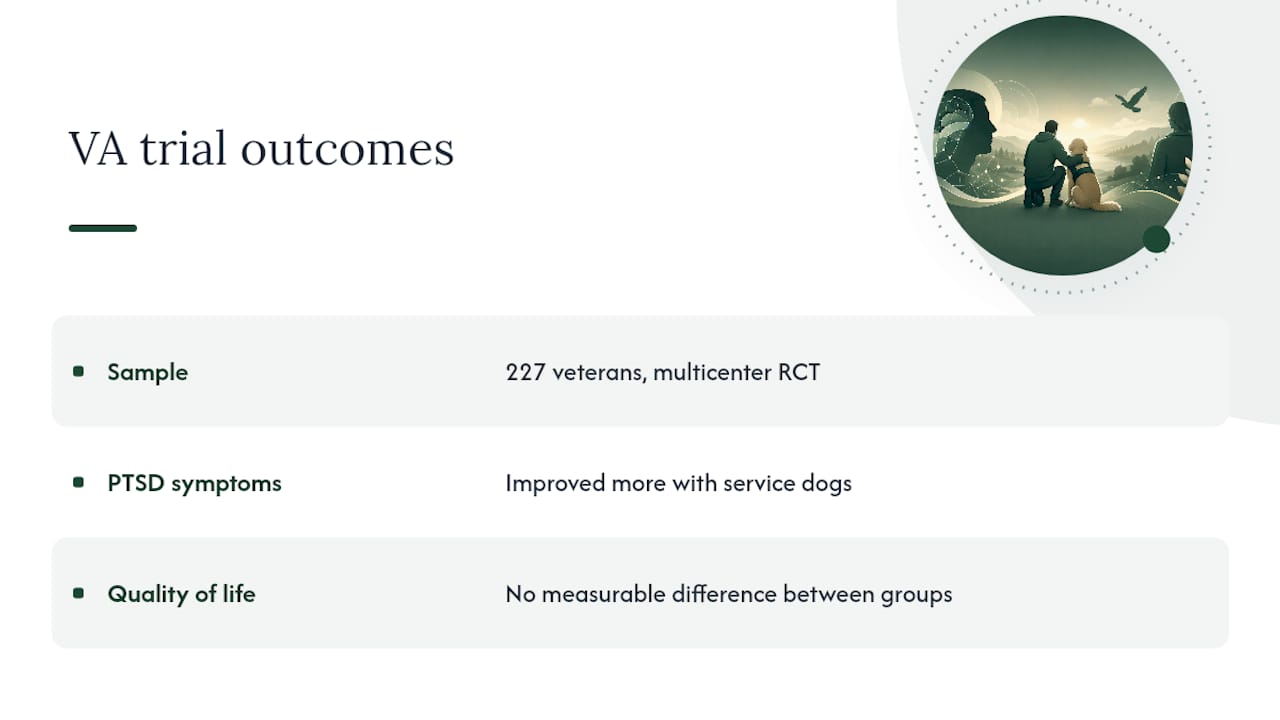
That trial delivered a genuinely mixed result. A VA multicenter randomized trial comparing service dogs against emotional support dogs in 227 veterans with PTSD found some improvement in PCL-5 symptom scores favoring the service dog group. On the primary quality-of-life outcome, though, there was no measurable difference between the two groups. Broader reviews of animal-assisted interventions echo that pattern: small-to-moderate benefits for anxiety and social functioning show up in some studies, but a PMC review of the literature points out that study quality varies widely and sample sizes are often too small to draw firm conclusions.
Why the inconsistency? Small samples, short study windows, and expectation effects all play a role, and caregiving demands can offset some of the calming benefit an animal provides. The practical takeaway: treat an ESA as a support that runs alongside evidence-based PTSD treatment, not a replacement for Cognitive Processing Therapy, Prolonged Exposure, or EMDR.
ESA vs. Service Dog vs. Psychiatric Service Dog: Know the Difference
These three terms get used interchangeably online, and that confusion causes real problems when someone shows up at a restaurant expecting ADA access with an animal that legally doesn’t have it.
- Service dogs are trained to perform a specific task tied to a disability (guiding someone who is blind, retrieving objects for someone with mobility limits) and carry ADA public-access rights, meaning they can go into restaurants, stores, and other public spaces.
- Psychiatric service dogs are a category of service dog trained to do a task connected to a psychiatric disability, such as interrupting a dissociative episode or performing deep pressure therapy during a panic attack. They also carry ADA protections.
- Emotional support animals provide comfort through their presence, with no task training required. Under ADA rules, an ESA is explicitly not a service animal, since offering emotional comfort isn’t considered a trained task tied to disability. ESAs get FHA housing protection, not public-access rights.
If your PTSD symptoms call for a specific trained response, like breaking up a flashback in a crowded space, a psychiatric service dog may serve you better than an ESA. That route means months of training and real financial investment. For most people whose primary need is a calming presence at home, an ESA covers the ground that matters.
Getting a Legitimate ESA Letter: What to Actually Do
Only a licensed mental health professional can write an ESA letter that holds up, and their license needs to be valid in the state where they’re practicing. That rules out the online “registries” that sell certificates with no clinical involvement at all.
- Gather your treatment history: current diagnosis, any records from therapy or psychiatric care, and a plain description of how PTSD affects your daily functioning.
- Schedule an evaluation with a licensed clinician, in person or through a legitimate telehealth platform.
- Let the clinician assess whether an animal would meaningfully ease a specific limitation, not just confirm you’d like one.
- Get a letter that’s dated, signed, and includes the clinician’s license number and contact information.
Run the letter against this checklist before you hand it to a landlord: does it name the clinician’s credentials, state a disability-related need without over-sharing medical detail, and explain how the animal helps you function? HUD’s guidance backs each of these elements.
Pro Tip: Before you pay anyone for an ESA letter, look up their license number on your state’s licensing board website. A real clinician’s license is public record and takes about two minutes to verify. If a seller doesn’t give you a license number, walk away.

Red flags include instant letters issued with no evaluation, registries that call themselves “official” (no such federal registry exists), and vendors who promise your ESA will get public access rights. None of that is legitimate.
Where an ESA Actually Protects You: Housing, Public Access, and Travel
Three different legal frameworks apply here, and mixing them up is where most people run into trouble.
- Fair Housing Act (FHA): This is where ESAs matter most. Landlords with a no-pets policy must consider a reasonable accommodation request for an assistance animal and generally can’t charge a pet fee once the accommodation is granted. They can ask for documentation if your disability or need isn’t obvious, but per HUD, they cannot demand detailed medical records or a specific diagnosis.
- Americans with Disabilities Act (ADA): Public-access protections under the ADA apply to task-trained service dogs, not ESAs. Bringing an ESA into a restaurant or store on the strength of a letter alone isn’t protected by federal law.
- Air travel: Airline policy changed after 2020, and ESAs are generally no longer guaranteed carriage the way service animals are. Airlines now set their own rules for emotional support animals, so check the specific carrier’s policy before you book.
Know what a landlord can and can’t ask for. They can request a letter confirming disability-related need. They cannot ask what your diagnosis is, demand your therapy notes, or require a specific animal breed or certification that doesn’t exist.
Before You Get an ESA: The Responsibilities Nobody Talks About
An ESA is a real commitment, not just a legal workaround, and it’s worth thinking through before you bring one home.
- Daily costs add up fast: food, routine vet visits, grooming, and the emergency vet bill you didn’t budget for.
- There’s a real risk of leaning on the animal instead of doing the harder work of exposure-based treatment, which is why clinicians typically frame an ESA as a support that enables therapy participation, not a substitute for it.
- Housing logistics get complicated with roommates, HOA rules, or a future move to a building with a stricter pet policy.
- Talk it through with your clinician and anyone you live with before deciding: what specific symptom is this animal meant to help with, and what’s the plan if your living situation changes?
Pro Tip: Ask your clinician to set a check-in point, three or six months out, to reassess whether the ESA is genuinely supporting your treatment goals or just becoming another thing to manage.
Veterans and ESAs: What VA Guidance and Research Actually Show
The VA’s position is measured rather than enthusiastic. Its own guidance acknowledges that dog ownership can lift mood and companionship has real value, while stating plainly that evidence isn’t yet strong enough to call dogs a treatment for PTSD. That’s part of why the VA ran its own randomized trial, which found a modest PCL-5 improvement for service dogs over emotional support dogs but no difference on overall quality-of-life measures.
Veterans pursuing an ESA or weighing a service dog have real resources to lean on:
- VA Vet Centers for community-based counseling and referrals
- VA mental health clinics for clinical evaluation and treatment planning
- The Veterans Crisis Line for immediate support during a crisis
- VA benefits counselors for questions about what’s covered and what isn’t
Note that VA does not currently provide service dogs for PTSD as a standard benefit, though related care may be available when clinically indicated.
How Supportpet Verifies Clinicians and Flags Scams
Supportpet.org exists to cut through the noise around ESA letters, explaining the real difference between ESAs and service dogs and warning readers away from vendors selling shortcuts that don’t hold up legally.
Watch for these signs a seller isn’t legitimate:
- Instant letters issued without any clinical evaluation
- “Official” registries or certifications, since no federal ESA registry exists
- Promises of public access rights that ESAs don’t legally have
Before you accept any letter, verify the clinician’s license number with your state board, confirm the letter lists real contact information, and make sure the credentials match a licensed mental health profession in your state.
A Note on Using an ESA Without Losing Sight of Treatment
An ESA works best as a bridge, something that makes it easier to show up for therapy, sleep through the night, or leave the house on a hard day, not as a wall between you and the exposures that actual PTSD treatment requires. Set a functional goal with your clinician, revisit it periodically, and have a real plan for the animal’s care before you commit. The animal should expand your life, not shrink the parts of it that still need work.
— Erik
Start With a Clinician, Not a Certificate Website
Getting an ESA letter shouldn’t mean gambling on a website that sells instant paperwork with no clinical evaluation behind it. Supportpet.org walks you through the legitimate path: what a licensed clinician actually assesses, what a HUD-compliant letter needs to include, and how Fair Housing Act protections apply once you have one in hand.
Where most guides stop at generic advice, Supportpet breaks down exactly which vendors to avoid and how to verify a clinician’s license before you pay for anything. If you’re ready to figure out whether your PTSD symptoms fit the clinical bar for an ESA, start with Supportpet’s ESA rights guide to see what a legitimate evaluation looks like and how to find a licensed professional near you.
Sources
- Dogs and PTSD - PTSD: National Center for PTSD
- Study of Costs and Benefits Associated with the Use of Service Dogs — Monograph 1 (VA research)
- Ada
- HUD — Assistance animals