
An ESA housing addendum is a lease amendment that records an approved emotional support animal as a reasonable accommodation under the Fair Housing Act, not a pet policy add-on. Once a landlord approves the request, HUD guidance says the animal isn’t a pet in the eyes of the law, which means standard pet fees and deposits generally don’t apply, and documentation demands are limited to what actually verifies a disability-related need.
TL;DR:
- An ESA housing addendum must specify that the accommodation was approved under the Fair Housing Act and clearly state that no pet fees or deposits apply.
- Landlords should only request a recent, licensed clinician’s letter confirming the disability-related need for the animal, avoiding demands for full medical records or registry IDs.
- The addendum should include tenant and animal descriptions, obligations like vaccination and waste cleanup, and clauses for removal conditions tied to threats or damage.
- Handling ESA requests involves a documented, step-by-step process including timely logging, a reasonable review period, and an individualized assessment based on HUD guidance.
- State laws like California’s can impose stricter requirements, so landlords must review local rules and adapt templates accordingly and consult legal counsel if needed.
Table of Contents
- What an ESA housing addendum is and when to use it
- Federal legal basis: FHA, HUD guidance, and the ADA distinction
- Key provisions every ESA housing addendum should include
- Step-by-step: how landlords should handle an ESA accommodation request
- Documentation: what landlords can and cannot request
- Tenant and landlord responsibilities, liability, and enforcement
- State notes and common special rules to watch for (California example)
- Free ESA housing addendum template and a short customization checklist
- Why plain-language guidance beats legal jargon here
- Get the addendum template and step-by-step guide
- Sources
- FAQ
What an ESA housing addendum is and when to use it
An ESA housing addendum amends an existing lease to spell out the terms of approved accommodation. It doesn’t replace the lease. It sits alongside it, documenting that both parties agree an emotional support animal will live in the unit under specific, written terms.
Landlords sometimes try to fold this into a standard pet addendum. That’s a mistake, and a costly one, because pet addenda typically include fees, deposits, or breed restrictions that don’t legally apply to a verified assistance animal. A dedicated ESA addendum:
- Confirms the accommodation was reviewed and approved under the Fair Housing Act
- Sets clear behavioral and care expectations for the tenant
- Protects the landlord by documenting the decision-making process
- Avoids confusing an emotional support animal with a service animal under the Americans with Disabilities Act, which is a narrower, differently regulated category
That last point trips up a lot of property managers. Service animals fall under ADA rules. Emotional support animals fall under the FHA. Different law, different playbook.
Federal legal basis: FHA, HUD guidance, and the ADA distinction
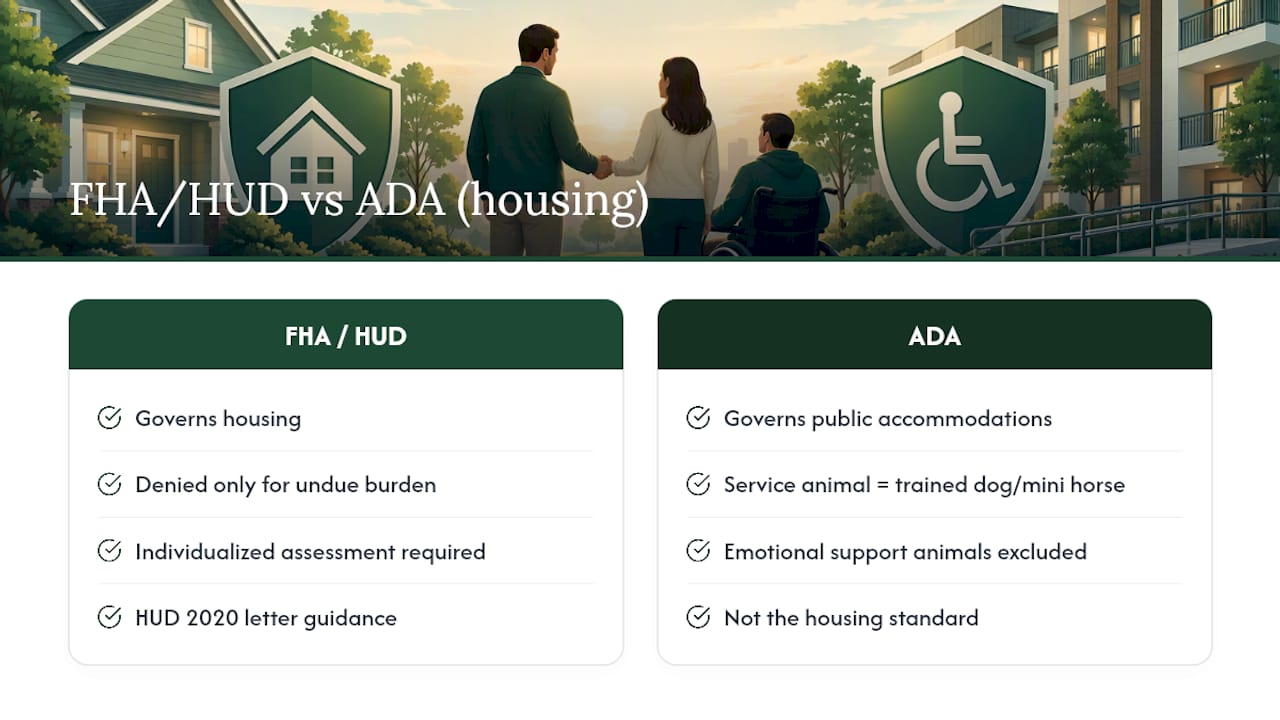
The Fair Housing Act sets the test landlords must apply. According to HUD’s assistance animals guidance, a request can be denied only if it creates an undue financial or administrative burden, fundamentally alters the housing operation, or the specific animal poses a direct threat that can’t be reduced through reasonable modifications.
The core standard: HUD requires an individualized assessment for every ESA request. Blanket bans, automatic denials, and one-size-fits-all fee waivers all violate the spirit of that requirement, according to HUD’s enforcement guidance.
HUD’s 2020 notice on assessing accommodation requests goes further, laying out what a clinician’s letter should contain and warning landlords against demanding more medical detail than necessary.
The ADA muddies things for people who confuse the two frameworks. Under ADA rules, a service animal is a trained dog (or, in limited cases, a miniature horse) performing a specific task for a person with a disability. Emotional support animals don’t meet that definition. That distinction mostly matters in public accommodations like restaurants and stores, not housing, where the FHA governs instead.
Key provisions every ESA housing addendum should include
A solid addendum isn’t long, but it has to hit specific points. Skip one, and you’ve created a document that either fails to protect the landlord or fails to honor the tenant’s rights.
- Reference to the accommodation decision: a line noting the request was reviewed and approved under the FHA
- Fee and deposit language: an explicit statement that no pet fee, pet rent, or deposit applies to the verified ESA
- Animal description: species, breed if known, and general description, without over-specifying in ways that create new restrictions
- Tenant obligations: vaccination compliance where required by local law, waste cleanup, noise control, and leash rules in common areas
- Removal clause: conditions under which the accommodation could be revisited, tied to direct threat or property damage, not general annoyance
- Confidentiality clause: a commitment to keep any medical documentation in a separate, restricted file
- Signatures and date: both parties, with the effective date of the accommodation
Pro Tip: Never hand a tenant a generic pet addendum and just cross out the word “pet.” Those forms are built around fees, deposits, and breed limits that don’t legally apply to a verified ESA, and reusing one is a common way landlords accidentally create an FHA violation.
Step-by-step: how landlords should handle an ESA accommodation request
The process matters as much as the paperwork. HUD calls this the interactive process. Skipping steps is where most disputes start.
- Log the request the day it arrives. Note the date and method (email, letter, verbal followed by written confirmation).
- Determine if the need is obvious. If the disability and the disability-related need for the animal are apparent, you generally can’t ask for documentation at all.
- Ask only permissible follow-up questions. When the need isn’t obvious, request a letter from a licensed clinician addressing the disability-related need, nothing more.
- Review and decide within a reasonable window. There’s no fixed federal deadline, but delay itself can become a fair housing complaint.
- Put the outcome in writing. If approved, execute the ESA addendum. If denied, document the individualized reasoning tied to undue burden, fundamental alteration, or direct threat.
Documentation: what landlords can and cannot request
Landlords can request a letter from a licensed healthcare provider confirming a disability-related need for the animal when that need isn’t obvious. That’s the ceiling, not the floor for more.
What crosses the line: demanding full medical records, requiring a notarized statement, or insisting on a registry ID or “certification” as a condition of approval. HUD guidance is direct on this. Assistance animal registries are not a legal requirement anywhere, and no legitimate clinician’s letter needs one attached.
A few practical checks help separate a legitimate letter from a rubber stamp:
- Confirm the letter comes from a licensed provider (therapist, physician, psychiatrist, licensed clinical social worker)
- Check that the letter references an actual, ongoing clinical relationship, not a single online questionnaire
- Look for a recent date, ideally within the past year, showing the assessment isn’t stale
Tenant and landlord responsibilities, liability, and enforcement
Approval doesn’t erase financial accountability. Tenants stay on the hook for actual damage the animal causes, and landlords can still pursue normal deposit deductions or repair costs the same way they would for any tenant-caused damage.
Landlords also can’t forbid an animal outright except in narrow direct-threat situations, and even then, only after an individualized assessment, not a general policy against a species or breed.
- Tenants should photograph the unit’s condition before the animal moves in and after move-out
- Landlords should document specific incidents, not general complaints, before pursuing removal
- Complaints about denied or mishandled requests can be filed with HUD’s Office of Fair Housing and Equal Opportunity (FHEO)
- Remedies through FHEO complaints can include policy changes, damages, and in some cases civil penalties
State notes and common special rules to watch for (California example)
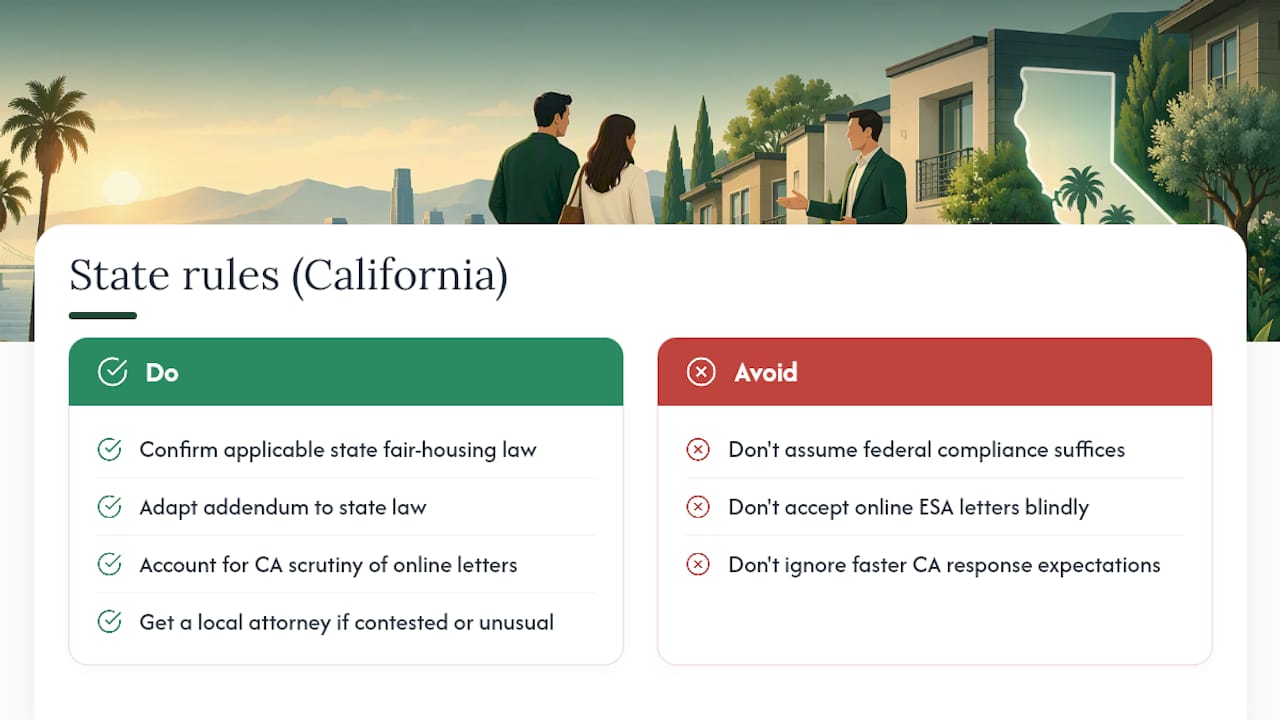
Federal law sets the floor, not the ceiling. States can and do layer on additional protections, and California is the example that comes up most often in landlord and tenant questions alike.
California’s Fair Employment and Housing Act overlaps with the FHA but adds its own scrutiny, particularly around online ESA letters issued without any real clinical relationship. The California Apartment Association’s guidance also flags faster response expectations for landlords handling these requests compared to the general federal standard.
If you’re operating in California, or any state with its own fair housing statute, don’t assume a federally compliant addendum automatically satisfies state law. Adapt the template language and, when a request looks contested or unusual, get a local attorney to review it before you respond.
Free ESA housing addendum template and a short customization checklist
A usable ESA addendum template needs a handful of fields kept intact no matter how much you customize the rest: tenant name, a description of the animal, the approval date, and signature lines for both parties.
- Keep the bracketed fields for tenant name, animal description, and approval date. Don’t delete them to save space.
- Attach only what’s necessary. That typically means the clinician’s letter and, if required by local ordinance, proof of vaccination or licensing, nothing diagnostic.
- Store medical documentation separately. Keep the clinician’s letter in a confidential file apart from the general lease file, accessible only to people who need it.
- Review annually or at lease renewal, since some jurisdictions expect periodic reconfirmation for long-term tenancies.
For a downloadable version of this checklist along with a plain-language rights breakdown, Supportpet’s ESA guide walks through the same fields in more depth.
Why plain-language guidance beats legal jargon here
This resource exists because most people trying to navigate an ESA accommodation request aren’t lawyers, and they shouldn’t have to read federal notices to understand their rights. The goal here has always been demystifying the actual FHA and HUD standards while calling out the registry and certificate scams that prey on renters who don’t know better.
That said, this article is educational, not a substitute for legal advice. If a request gets denied, or a landlord and tenant end up in a real dispute, especially one involving state-specific rules like California’s, talk to an attorney who handles fair housing cases before things escalate.
— Erik
Get the addendum template and step-by-step guide
Most of the friction in ESA housing disputes comes from one thing: nobody involved has a clear, correctly worded document to work from. The guide gives a plain-language explanation of rights and a downloadable ESA housing addendum template built around the HUD provisions covered above, so you’re not improvising language on a lease amendment that has real legal weight.
Whether you’re a tenant preparing an accommodation request or a landlord trying to draft something that won’t create fair housing exposure, the Supportpet ESA guide walks through each clause, flags the documentation scams to avoid, and gives you a starting template instead of a blank page. Visit Supportpet to download the template and see the full breakdown of what belongs in your addendum.
Sources
- Hud
- Assessing a Person’s Request to Have an Animal as a Reasonable Accommodation Under the Fair Housing Act (HUD notice)
- ADA: Service animals and assistance animals (2010 requirements)
FAQ
Do apartments actually check ESA letters?
Yes, most landlords review the letter to confirm it comes from a licensed clinician and addresses a disability-related need. They generally can’t verify the diagnosis itself or demand medical records, but they can confirm the letter meets HUD’s documentation standard.
What are the current rules for emotional support animals in housing?
The controlling rule remains the Fair Housing Act, which requires landlords to grant reasonable accommodations unless the request creates undue burden, fundamentally alters operations, or the specific animal poses a direct threat. There’s no registry requirement anywhere, despite what many paid certificate websites claim.
What documents do apartments need for ESA animals?
A letter from a licensed healthcare provider confirming a disability-related need is typically sufficient. Landlords cannot legally require registry IDs, notarized statements, or full medical records under HUD’s guidance.
Can an apartment reject an ESA letter?
An apartment can reject a request only after an individualized assessment shows undue burden, fundamental alteration, or a direct threat tied to that specific animal. A landlord can also question a letter that shows no evidence of a real clinical relationship, which is a common issue with online-only ESA letter mills.
How is an ESA housing addendum different from a service animal policy?
An ESA addendum documents a Fair Housing Act accommodation, while service animals fall under the narrower ADA definition limited to trained dogs performing specific tasks. Housing providers apply FHA standards to ESAs and generally don’t need a formal addendum for ADA service animals, since those animals aren’t treated as pets under either law.