
No. Under the Fair Housing Act, landlords cannot charge pet fees, pet deposits, or pet rent as a condition of allowing an emotional support animal into a rental unit. An ESA is treated as a reasonable accommodation, not a pet, so the usual “pet policy” charges do not apply. Landlords can still bill you for actual damage the animal causes, using standard security deposit rules, and narrow exceptions to the accommodation requirement do exist. The sections below cover both.
TL;DR:
- Landlords cannot charge pet fees, deposits, or rent for emotional support animals, but can bill for damages caused by the animal.
- A valid ESA letter must come from a licensed mental health professional with whom you have an actual clinical relationship; online registrations are not recognized.
- Denials of ESA requests are only lawful if there is an undue financial burden or a confirmed direct threat from the specific animal.
- State laws often reinforce federal protections and can provide faster or clearer complaint processes than federal avenues.
- Many illegal charges stem from landlords and tenants misunderstanding or misapplying the regulations, highlighting the importance of proper documentation and awareness.
Table of Contents
- What Landlords Can and Cannot Charge for ESA Pet Fees
- Service Animals vs. Emotional Support Animals: What’s the Difference?
- ESA Documentation Requirements: What Landlords Can and Can’t Ask
- When Can a Landlord Deny an ESA Request?
- What to Do if You’re Charged an Illegal Fee
- How State Rules Add to Federal ESA Protections
- Avoiding ESA Scams: Why Legitimate Documentation Matters
- Get Help Preparing Your ESA Documentation
- Where to Verify the Rules Yourself
- Sources
- FAQ
What Landlords Can and Cannot Charge for ESA Pet Fees
The line is simple once you see it: landlords can charge for damage, not for the animal’s existence. HUD’s guidance on assistance animals makes clear that a housing provider must waive pet deposits, pet fees, and pet rent when the animal is an ESA approved as a reasonable accommodation. That rule holds even in buildings with strict “no pets” policies or breed and weight limits, because an ESA is not legally a pet.
What’s off the table:
- Nonrefundable pet fees or “pet rent” added to monthly rent
- A separate pet deposit on top of the normal security deposit
- Pet insurance requirements as a condition of approval
- Any fee just to process the accommodation request itself, according to HUD’s FHEO program page
What’s still fair game: if your ESA chews through the baseboards or stains the carpet, the landlord can deduct repair costs from your general security deposit, the same way they’d handle damage from a leaky fish tank or a candle burn. Keep photos, move-in condition reports, and repair invoices. That paper trail is what separates a legitimate damage claim from an illegal pet surcharge dressed up as one.
Service Animals vs. Emotional Support Animals: What’s the Difference?
Confusing these two categories is where most disputes start. They fall under different federal laws, with different rules:
- Service animals are covered by the Americans with Disabilities Act. They’re trained to perform a specific task tied to a disability, like guiding someone who is blind or alerting to a seizure. Ada limits this category almost entirely to dogs, and it governs public access, not housing.
- Emotional support animals fall under the Fair Housing Act, not the ADA. An ESA provides comfort through companionship and doesn’t need task-specific training. This is the category that governs your rights as a renter.
- Ordinary pets get none of these protections. A landlord can charge whatever fee they want for a pet that isn’t an approved assistance animal.
Here’s why the distinction matters in practice: a coffee shop can legally turn away someone’s ESA cat because the ADA doesn’t require public businesses to admit emotional support animals. That same cat, though, cannot be charged a pet deposit by a landlord, because FHA housing protections don’t hinge on public-access rules at all. Two different laws, two different outcomes, same animal.
ESA Documentation Requirements: What Landlords Can and Can’t Ask
There’s no official ESA registry, and no card, certificate, or database that makes an ESA “official” in the eyes of federal law. HUD is explicit that the only documentation that carries weight is a letter from a licensed health or mental health professional who has an actual clinical relationship with you.
That letter needs to confirm you have a disability and that the animal provides support related to it. Landlords are allowed to ask for this when your disability or need isn’t obvious, but they cannot demand:
- Detailed medical records or a full diagnosis
- Access to your therapist for follow-up questioning
- Specific training certifications (ESAs don’t need training)
- Proof through an online registry or “official” ID card
That last point is where a lot of tenants get burned. Paid ESA registries and instant-certificate websites carry no legal standing with HUD, no matter how official their PDF looks. A licensed clinician with a real treatment relationship to you is the only credible source.
Pro Tip: If a website offers to “certify” your ESA for a fee within minutes of an online quiz, that’s a red flag. A legitimate letter comes from a provider who has actually evaluated you, not a form you filled out five minutes ago.
When Can a Landlord Deny an ESA Request?
Denials aren’t automatic just because a landlord doesn’t like animals. HUD requires an individualized assessment, meaning the landlord has to evaluate your specific situation and your specific animal, not apply a blanket policy.
Two narrow exceptions allow a lawful denial:
- Undue financial and administrative burden. This is a high bar, rarely met by a routine accommodation request, and it depends on the landlord’s size and resources.
- Direct threat. The landlord needs objective evidence the specific animal has behaved dangerously, not a general assumption about its breed or size.
Breed and size restrictions generally cannot be applied to assistance animals. A no pit bulls policy doesn’t override an ESA accommodation unless the landlord has actual evidence that particular animal poses a risk. Speculation about a breed’s reputation doesn’t count as evidence.
Damage liability works the same regardless of whether a denial applies. If the animal is approved and later causes damage, the landlord deducts repair costs from your existing security deposit. They still cannot layer a separate ESA pet deposit or pet fee on top of that, per HUD’s FHEO notice.
What to Do if You’re Charged an Illegal Fee
Getting hit with an illegal pet fee for your ESA is more common than it should be, largely because plenty of property managers simply don’t know the rules. Here’s the practical path forward:
- Document everything. Save your ESA letter, lease agreement, any fee invoices, and all written communication with the landlord or management company.
- Send a written request to rescind the fee. Reference the Fair Housing Act directly and attach your clinician letter. Many disputes end here once management realizes the exposure.
- File a complaint if they refuse. You can file with HUD’s FHEO office or the Department of Justice’s Civil Rights Division, which handles fair housing enforcement alongside HUD.
- Escalate locally if needed. Small-claims court can recover fees already paid, and a tenant advocacy group or attorney can advise if the landlord retaliates or refuses to budge.
HUD investigates fair housing complaints and can pursue administrative action, including ordering a refund of improperly collected fees. Most disputes resolve at the written-request stage. It rarely takes a full federal complaint to get an illegal charge reversed.
How State Rules Add to Federal ESA Protections
The Fair Housing Act sets the floor, but it isn’t always the whole picture. Some states publish their own guidance that reinforces or clarifies the federal standard, sometimes with a faster complaint process than a federal filing.
Massachusetts, for instance, explicitly states that assistance animals are not pets for housing purposes and spells out both tenant responsibilities and provider obligations in plain language. New York offers a similar state-level FAQ confirming that landlords cannot require extra security deposits or insurance for an assistance animal.
Before you assume your state works exactly like the federal rule, or exactly like a neighboring state, check directly:
- Your state’s housing authority or human rights commission
- Your state attorney general’s consumer protection division
- A local civil rights or fair housing office, which may handle complaints faster than a federal filing
Treat state pages as an added layer of protection, not a replacement for federal law. When state and federal rules differ, the stronger tenant protection usually applies.
Avoiding ESA Scams: Why Legitimate Documentation Matters
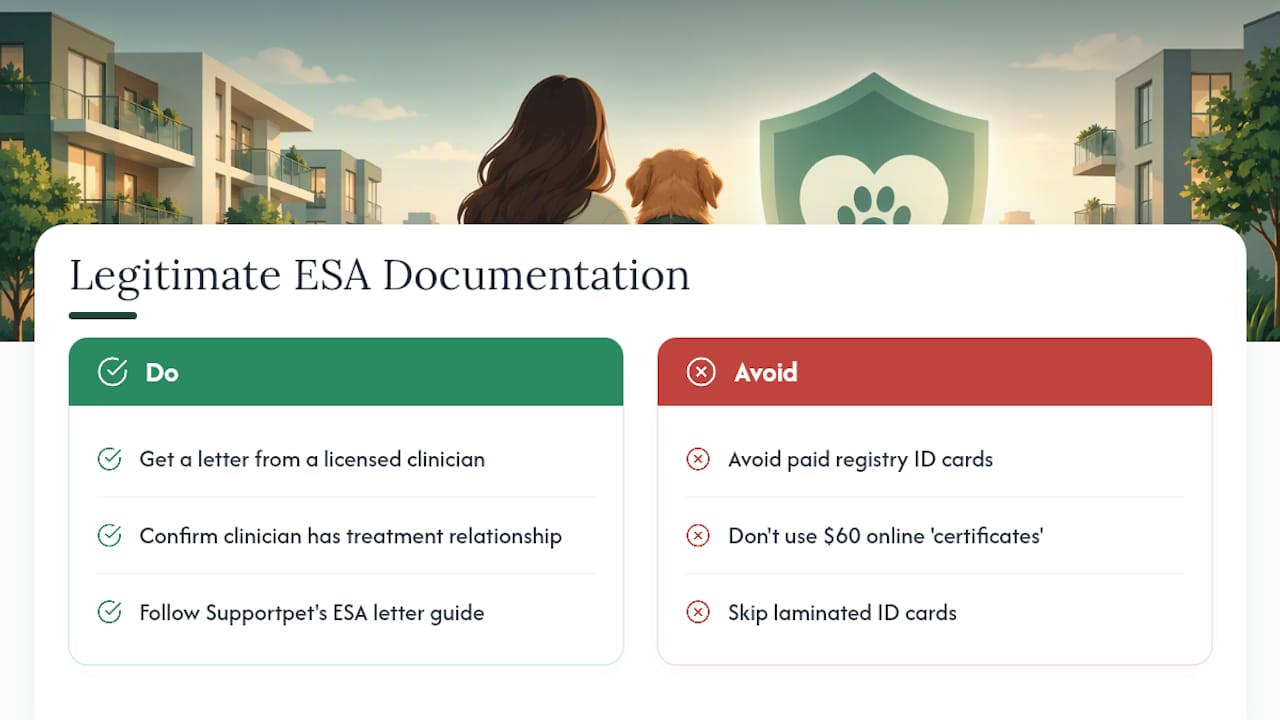
An emotional support animal is a reasonable accommodation, not a workaround for a landlord’s pet policy, and that distinction is exactly what gets lost when tenants go looking for the fastest paperwork instead of the right paperwork. The paid registry industry thrives on that confusion, selling ID cards and “certificates” that carry zero legal weight with HUD or any landlord who actually knows the rules.
The tenants who run into trouble almost always have the same story: a $60 online certificate instead of a letter from someone who has actually treated them. Skip that path entirely. A real letter from a licensed clinician with a genuine treatment relationship to you is worth more than any laminated card, and it’s the only thing that holds up if a landlord pushes back or a dispute lands in front of HUD. Supportpet’s guide to getting a legitimate ESA letter walks through exactly what that documentation needs to include before you ever hand it to a landlord.
— Erik
Get Help Preparing Your ESA Documentation
This resource offers a plain-language rulebook the registry sites won’t: what a valid ESA letter actually requires, what your landlord is and isn’t allowed to ask for, and how to spot a scam before you pay for it.
Instead of guessing whether a $50 online certificate will hold up, you get documentation checklists built around what HUD and the Fair Housing Act actually require, plus a straight answer on what a reasonable accommodation request should say to your landlord. If you’re renting with a mental health condition and need an ESA letter that will actually stand up to scrutiny, start with Supportpet’s guide to ESA letters and housing rights and get your documentation in order before you submit anything to your landlord.
Where to Verify the Rules Yourself
Primary sources beat secondhand summaries, including this one. Check these directly:
- HUD — Assistance animals: documentation standards and general FHA guidance
- HUD FHEO notice: the fee prohibition and individualized assessment standard
- DOJ Civil Rights Division: enforcement examples and complaint routes
- Mass: a state-level example of clarifying guidance
This article is general information, not a substitute for advice from a qualified lawyer. Consult a qualified legal professional about your own circumstances before acting on anything here.
Sources
- HUD — Assistance animals
- HUD FHEO notice: Service animals and assistance animals
- Civil Rights Division | U.S. Department of Justice (HUD examples)
- Mass
FAQ
Do I have to pay a pet fee if I have an ESA?
No. Under the Fair Housing Act, landlords cannot charge pet fees, pet deposits, or pet rent for an approved emotional support animal, according to HUD. You may still be billed for actual damage the animal causes, deducted from your standard security deposit.
Is ESA registration required to get housing protections?
No. There is no federal ESA registry, and paying for one does not create any legal protection. What actually matters is a letter from a licensed clinician who has a genuine treatment relationship with you, which is the only documentation HUD recognizes.
How much does it cost to get an ESA letter?
Costs vary depending on the clinician and whether you already have a treatment relationship with one. Supportpet’s guide to legitimate ESA letters explains what to look for and how to avoid overpriced instant-certificate sites that provide no real legal standing.
Do landlords actually verify ESA letters?
Some do, and they’re legally allowed to confirm the letter came from a licensed provider with a real clinical relationship to you, but they cannot demand medical records or contact your therapist for details. Landlords increasingly know to look for red flags like instant online certificates, since those carry no weight under HUD guidance.
Can a landlord deny my ESA request?
Yes, but only on narrow grounds: undue financial or administrative burden, or a direct threat backed by objective evidence about that specific animal. Blanket breed or size bans generally cannot be used to deny an ESA under the individualized assessment standard.