
No federal law requires an emotional support animal to complete training or hold a certification. The legitimate documentation that matters for housing protections is a letter from a licensed clinician, not a training certificate or registry listing. Unlike service animals, which must be trained to perform a specific task, ESAs qualify through a clinical recommendation and reasonable expectations around behavior. This guide covers documentation, landlord rules, behavior standards, common scams, and a practical checklist.
TL;DR:
- An ESA does not require formal training or certification; a letter from a licensed clinician confirming the need is all that is legally necessary.
- Housing providers can only request an up-to-date, verifiable letter specifying your disability and the animal’s support role, but they cannot demand medical records or registration proof.
- A valid ESA letter includes the clinician’s license number, contact information, a clear statement of disability-related support, and a dated signature; online or instant certificates are illegitimate.
- Proper animal behavior, like basic obedience and good socialization, is important to prevent housing disputes, but formal training is not legally mandated for ESAs.
- Most legal disputes arise from missing documentation, outdated letters, or animals that have not been veterinary-checked, not from the animal’s breed or size.
Table of Contents
- How you qualify an animal as an ESA
- Training versus behavior: what the law actually expects
- What a clinician should evaluate before writing your letter
- What housing providers can and cannot ask you for
- How to spot ESA scams and confirm a letter is legitimate
- A step-by-step path to a valid ESA letter
- A fair way to think about ESA rights and responsibilities
- Where to find plain-language guidance on ESA letters
- Where to verify the rules yourself
- Sources
- FAQ
How you qualify an animal as an ESA
Qualifying an animal as an ESA does not involve training records or paperwork filed with any agency. It hinges on a recommendation from a licensed clinician, someone such as a physician, psychiatrist, psychologist, licensed clinical social worker, or nurse practitioner who has assessed you and determined that the animal helps manage a diagnosed condition, according to HUD’s guidance on assistance animals.

Housing providers can request supporting documentation when a disability or the disability-related need for the animal is not obvious. What they cannot do is demand medical records, a specific diagnosis, or proof of registration with any national database, since no such database carries legal weight.
A letter that holds up under scrutiny typically includes:
- The clinician’s name, license type, and contact information
- A statement that you have a condition covered under the Fair Housing Act
- A clear explanation that the animal provides support related to that condition
- A dated signature on letterhead or a verifiable format
Pro Tip: Ask your clinician to include their license number directly in the letter. It saves time if a housing provider ever asks to verify the credential.
Training versus behavior: what the law actually expects
Emotional support animals are not service animals, and the law treats them differently on purpose. Service animals under the ADA must be dogs trained to perform a specific task tied to a disability, such as guiding someone or interrupting a panic episode. ESAs carry no such training mandate; their role is companionship and comfort, not task performance.
That said, behavior still matters in practice. A housing provider can deny or later withdraw an accommodation if the animal poses a direct threat, causes significant property damage, or is not housebroken. None of that requires formal training, but it does require some groundwork:
- Basic obedience so the animal responds to you in shared spaces
- Early socialization around neighbors, elevators, and other pets
- A veterinary checkup to rule out health or behavior issues
- Behavior counseling if anxiety or reactivity shows up early
Pro Tip: A few weeks of basic obedience work, even informal sessions at home, tends to prevent most of the behavior complaints that put housing accommodations at risk.
What a clinician should evaluate before writing your letter
A responsible ESA letter comes from more than a quick conversation. Clinical researchers have proposed a four-part evaluation model that gives the recommendation real weight: legal knowledge of what qualifies as a disability-related need, a thorough assessment of the patient, an assessment of the animal’s suitability, and, where possible, observation of how the two interact, according to a peer-reviewed evaluation model.
In practice, that assessment often includes:
- Establishing a diagnosis that substantially limits a major life activity
- Documenting a clear connection between the animal’s presence and symptom relief, sometimes using tools like the GAD-7 anxiety scale
- Gathering collateral information about the animal’s temperament from a veterinarian or trainer
- Noting dated clinical observations rather than a single, undated impression
Clinicians who combine patient assessment with animal temperament information and, when feasible, a firsthand observed interaction produce letters that hold up better if a landlord or housing authority pushes back.
What housing providers can and cannot ask you for
The Fair Housing Act requires housing providers to make reasonable accommodations for assistance animals, including ESAs, and bars them from charging pet fees or pet deposits for these animals in most cases, per HUD’s assistance animal guidance. Breed and size restrictions that apply to pets generally do not apply to legitimate assistance animals either.
When your disability or need for the animal is not obvious, a housing provider may ask for documentation confirming both. Best-practice guidance for providers walks through applying the two-question service-animal test first, then evaluating any remaining support-animal request under Fair Housing Act procedures, according to HUD’s fair housing guidebook.
What a housing provider cannot legally do:
- Demand your full medical records or a specific diagnosis
- Require proof of training, certification, or registration
- Charge a pet fee or deposit for a qualifying assistance animal
- Reject an animal based solely on breed or size
Legitimate grounds for denial exist too. A provider can decline or later revoke an accommodation if the animal poses a direct threat to others, causes serious property damage, or is not housebroken, but these determinations are supposed to be individualized rather than based on assumptions about a breed or species.
How to spot ESA scams and confirm a letter is legitimate
The most common scam pattern looks the same across sites: pay a fee, answer a short quiz, and receive an instant “certificate,” ID card, or registration number within minutes. None of that carries legal standing, since no registry or certification is recognized under federal housing or disability law.
A valid letter looks different. It comes from an actual clinician who has evaluated you, states your need in plain terms, and includes verifiable contact information:
- Confirm the clinician’s license is active through your state’s licensing board
- Keep the clinic’s contact information on file in case a housing provider follows up
- Prefer an in-person visit or a legitimate telehealth appointment with a licensed provider over a one-question online form
Pro Tip: If a site promises a certificate before you have ever spoken to a licensed clinician, that is the clearest sign it will not hold up with a landlord.
A step-by-step path to a valid ESA letter
Getting this right takes a handful of concrete steps rather than a single form. Start by writing down your symptoms and how your animal helps, since specifics make the clinical evaluation faster and more accurate.
- Schedule an appointment with a licensed physician, psychiatrist, psychologist, or nurse practitioner
- Ask that the letter include their license number, contact details, a dated signature, and a clear statement of need
- Keep a copy of the clinician’s contact information in case your housing provider requests verification
- Get your animal a veterinary checkup and current vaccinations
- Consider basic obedience training or a Canine Good Citizen evaluation if your housing situation involves shared spaces
- Submit your accommodation request in writing, attach the letter, and respond promptly if the provider asks a clarifying question
Most disputes come from missing pieces, an undated letter, no license number, or an animal that has never seen a vet, rather than from an actual legal gap in your rights.
A fair way to think about ESA rights and responsibilities
Housing protections for ESAs exist because emotional support genuinely helps people manage real conditions, but that protection works best when paired with responsibility toward neighbors and the animal itself. A well-cared-for, reasonably well-behaved animal keeps the system credible for everyone who depends on it. If a request is wrongly denied, document everything and ask a housing counselor or attorney before assuming the fight is not worth it.
— Erik
Where to find plain-language guidance on ESA letters
This guide helps renters, students, and pet owners understand the process without selling certificates, registrations, or ID cards that carry no legal weight. The focus stays on legitimate clinician recommendations and the housing rights that actually protect you.
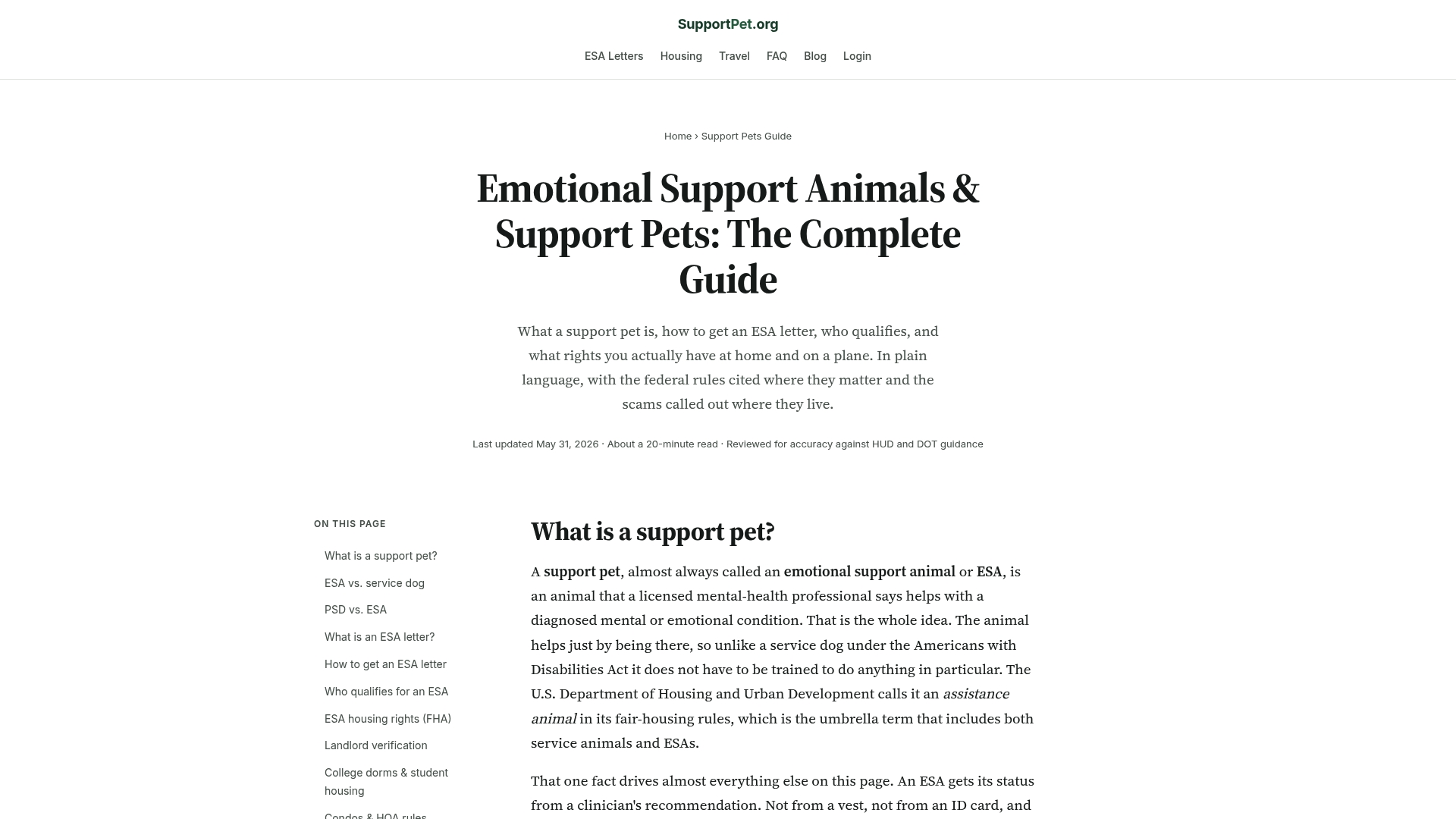
- Read the full rights guide for emotional support animals for a step-by-step breakdown of letters and housing protections
- Use it to prepare questions for your clinician before your appointment
- Check back before submitting an accommodation request if you are unsure what documentation to include
Visit Supportpet’s ESA letter and rights guide to work through the checklist before you approach your housing provider.
Where to verify the rules yourself
- HUD’s assistance animal guidance explains Fair Housing Act protections and fee restrictions for ESAs
- The ADA’s service animal FAQ clarifies how service animals differ from ESAs and what questions providers may legally ask
- The AVMA’s guidance on service, emotional support, and therapy animals covers animal welfare and clinician collaboration
- The peer-reviewed ESA evaluation model outlines best practices clinicians use when assessing a support-animal recommendation
This article is general information, not a substitute for advice from a qualified doctor. Consult a qualified healthcare professional about your own circumstances before acting on anything here.
Sources
FAQ
Do emotional support animals need to be trained?
No, emotional support animals are not legally required to complete training or hold a certification. What matters is a letter from a licensed clinician documenting your need, according to HUD’s assistance animal guidance.
What is the difference between an ESA and a psychiatric service animal?
A psychiatric service animal is trained to perform a specific task related to a disability, such as interrupting a panic attack, while an ESA provides comfort without task training. The ADA recognizes only trained service animals under its two-question test, not ESAs.
Can a landlord charge a pet fee for my ESA?
In most cases, no. Housing providers generally cannot charge pet fees or deposits for a legitimate assistance animal under HUD’s guidance, since the animal is not classified as a pet.
How do I know if an ESA letter or certificate is legitimate?
A legitimate letter comes from a licensed clinician who has evaluated you and includes their license number, contact information, and a dated signature. Instant online certificates or registration numbers sold without a clinical evaluation carry no legal standing.
What can a housing provider legally ask about my ESA?
When your disability or need is not obvious, a provider may ask for documentation confirming both, but cannot demand medical records or proof of training. Guidance in HUD’s fair housing guidebook outlines what documentation is and is not appropriate to request.