
Federal law sets no fixed numeric cap on how many emotional support animals you can have. The Fair Housing Act and HUD guidance require landlords to evaluate each ESA request individually, based on whether the specific animal is tied to your disability. That said, landlords retain narrow defenses like undue burden or documented risk, so the outcome hinges on paperwork. Prepare separate clinical documentation for each animal and ask for an individualized assessment before you move in.
TL;DR:
- Landlords can evaluate each emotional support animal request individually, and there is no fixed federal limit on how many ESAs a tenant can have.
- Separate, detailed clinician letters are essential, with each animal connected to a specific disability symptom or function, not a generic statement.
- Documentation should clearly state the disability, the functional limitation, how the animal relieves that limitation, and why it is necessary for housing equality.
- Landlords may deny requests based on documented risks, undue burden, or lack of a nexus between the animal and the disability; vague or interchangeable clinical statements are often rejected.
- Requests should be made in writing, with supporting records and an invitation to an interactive process, especially when requesting multiple ESAs or unusual species.
Table of Contents
- What the Fair Housing Act and HUD Say About Multiple ESAs Housing Requests
- The Nexus Test: Why Every ESA Needs Its Own Justification
- What Should an ESA Letter Say for Each Animal?
- When Can a Landlord Deny or Limit Multiple ESAs?
- How to Request Accommodation for Multiple ESAs
- Special Cases: Unusual Species, Small Units, and State Rules
- Do Airline and Public-Access Rules Match Housing Protections?
- Spotting Legitimate Clinician Documentation vs. Scams
- A Note on Documentation Over Confrontation
- Get the Full Guide to ESA Letters and Housing Rights
- Official Resources and Primary Sources to Consult
- Sources
- FAQ
What the Fair Housing Act and HUD Say About Multiple ESAs Housing Requests
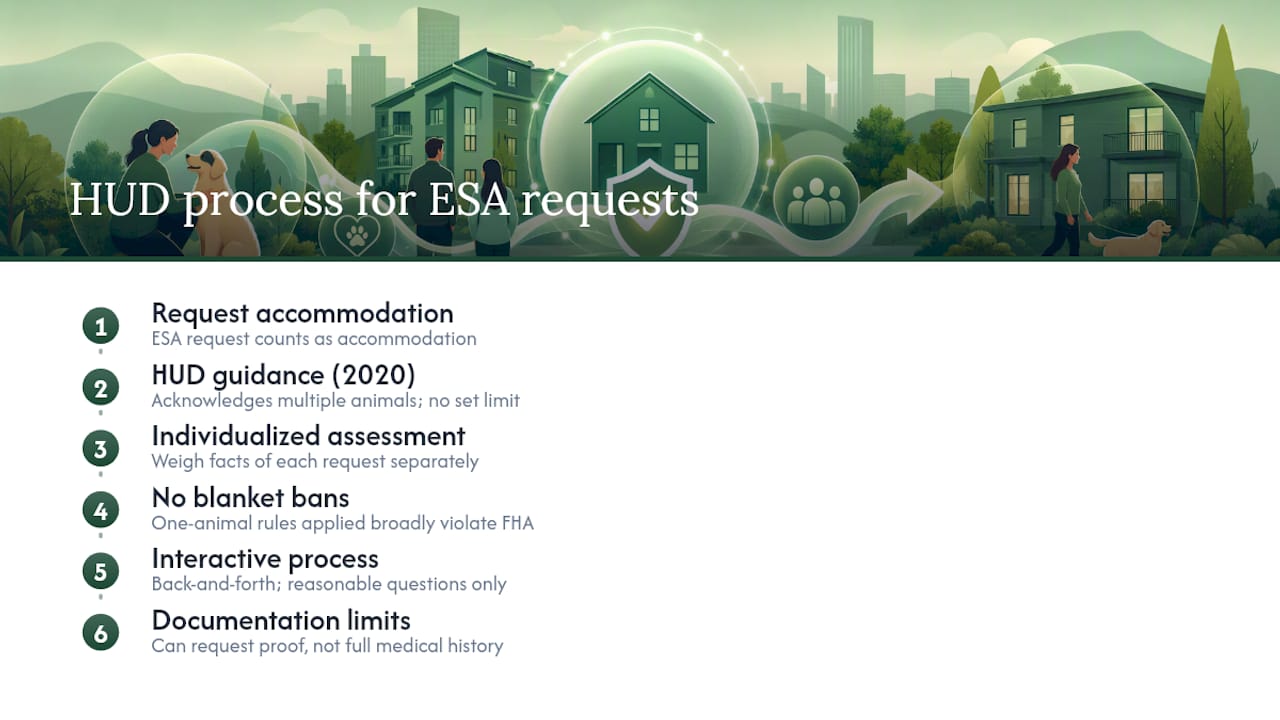
The Fair Housing Act doesn’t treat an emotional support animal as a pet. It treats the request as a reasonable accommodation, the same legal category as a wheelchair ramp or a reserved parking spot. That distinction changes everything about how a landlord has to respond.
HUD’s 2020 guidance (FHEO-2020-01) is the controlling document here, and it explicitly acknowledges that some accommodation requests involve more than one animal. Nowhere does it set a number. Instead, it requires housing providers to run what’s called an individualized assessment on each request, weighing the specific facts rather than applying a blanket rule.
That word “individualized” matters more than most tenants realize. HUD has found that flat policies limiting tenants to one assistance animal, applied without looking at the actual accommodation request, violate the FHA on their face. A landlord who says “we only allow one ESA per unit, period” is standing on legally shaky ground the moment a tenant files a documented request for a second animal.
The “interactive process” is the back-and-forth where a landlord can ask reasonable questions and you provide reasonable answers. Landlords may request documentation when your disability or need isn’t obvious, but they can’t demand your full medical history, a specific diagnosis, or details unrelated to the disability-animal connection. Understanding where that line sits protects you from overproducing information and protects the landlord from a legitimate refusal to comply.
The Nexus Test: Why Every ESA Needs Its Own Justification
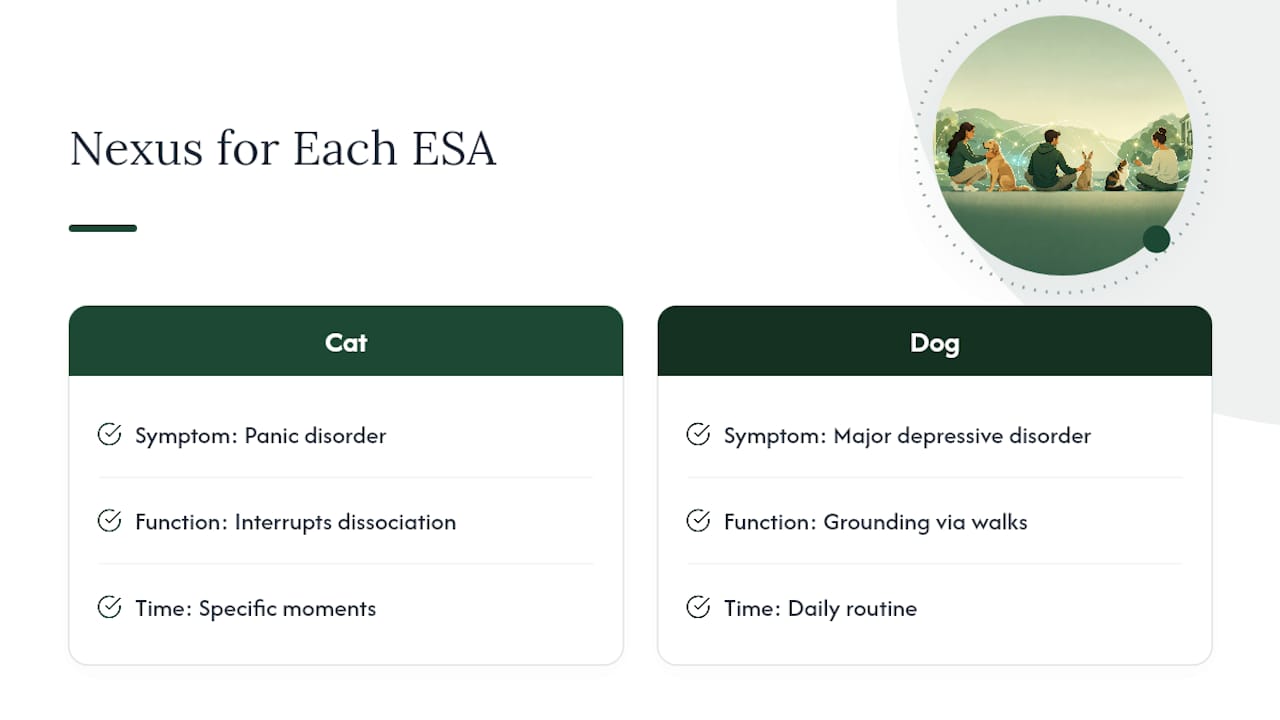
Nexus is the legal term for the link between your disability’s functional limitation and what a specific animal does to ease it. One clinician letter covering two animals with a vague “these animals help with my anxiety” line won’t hold up nearly as well as a letter that spells out distinct roles.
Picture a tenant with panic disorder and a separate diagnosis of major depressive disorder. One cat might interrupt the tenant’s dissociative episodes by demanding attention at a specific moment. A second animal, a dog, might provide a grounding routine of walks that counteracts depressive withdrawal. Different symptoms, different functions, different times of day. That’s a nexus for each animal, not a shared one.
Contrast that with two dogs described identically: “helps me feel calm.” A housing provider or, later, a fair housing investigator will read that as one justification duplicated, not two. Legal and clinical commentary consistently points to this as the most common reason multiple-ESA requests get denied: thin, interchangeable documentation rather than any real dispute about disability.
The fix is specificity. A clinician should tie each animal to a distinct symptom or a distinct major life activity the disability impairs, not a general statement like “helps with anxiety” floating free of context. If your second animal genuinely serves the same function as your first, that’s worth an honest conversation with your clinician before you submit anything. If the roles are genuinely distinct, that distinction needs to show up on paper in plain language.
What Should an ESA Letter Say for Each Animal?
A letter from a licensed healthcare provider carries the weight in this process, and its contents matter more than its length. Every letter should include the provider’s license type, license number, state of licensure, and contact information so a housing provider can verify legitimacy without guessing.
For each animal named in the letter, four elements need to appear:
- Confirmation of disability. The provider states you have a disability as defined under the FHA, without necessarily naming the diagnosis.
- The specific functional limitation. A description of how the disability limits a major life activity, such as sleep, concentration, or social functioning.
- How this particular animal relieves that limitation. Not a generic benefit, but the specific mechanism, whether that’s interrupting panic symptoms or providing a grounding routine.
- Necessity for equal use and enjoyment of housing. A statement connecting the animal to your ability to live in the unit on equal footing with other tenants.
One combined letter covering multiple animals works fine as long as each animal gets its own paragraph addressing these four points separately. Separate letters work too, though they create more paperwork to track. Supporting records, such as veterinary documentation or evidence of behavioral training, aren’t required by the FHA but can reduce friction with a skeptical property manager.
When Can a Landlord Deny or Limit Multiple ESAs?
A landlord’s denial has to rest on specific, evidence-based grounds, not a general preference for fewer animals. The recognized defenses include a missing nexus for one of the animals, a direct threat that’s documented and individualized rather than assumed from breed or species, and undue financial or administrative burden that the landlord can actually demonstrate.
Fundamental alteration of the housing operation is another valid defense, though it’s rarely invoked successfully outside unusual property types. Documented prior damage or aggressive behavior by a specific animal can justify denying that one animal, but it doesn’t automatically sink a request for a different, well-behaved one.
Owner-occupied buildings with a small number of units and certain owner-occupied duplexes fall under FHA exemptions in some cases, which changes the analysis entirely. If you’re renting a room in a building the owner lives in, ask early whether that exemption applies to your situation.
Following the process matters as much as having good documentation. Respond to reasonable requests for information, and if you’re denied, ask for the reasons in writing. That paper trail becomes essential if the dispute escalates.
How to Request Accommodation for Multiple ESAs
Getting this right starts before you write anything to your landlord.
- Talk to your clinician about each animal’s distinct role. Don’t assume the provider already knows the difference between what your first and second animal do for you. Spell it out.
- Gather supporting records. Veterinary history, any behavioral training documentation, and notes on when each animal started helping with specific symptoms all strengthen your file.
- Draft a clear written request. State that you’re requesting a reasonable accommodation, attach the clinician letter(s), and identify the unit and animals by name and species.
- Ask explicitly for an interactive process. Invite the landlord to raise questions rather than issue a silent denial.
- Track every communication in writing. Emails beat phone calls for a reason: they create a timestamped record.
- If denied, request the reasons in writing. Then consider a HUD complaint, a state fair housing agency complaint, or a consultation with an attorney who handles disability housing cases.
Pro Tip: Send your request by email or certified mail rather than a verbal conversation with the property manager. A landlord who “doesn’t recall” a hallway conversation can’t dispute a dated, written record.
Special Cases: Unusual Species, Small Units, and State Rules
Requesting an unusual species, a snake or a pig rather than a dog or cat, invites closer scrutiny. Be ready for your clinician’s letter to explain specifically why a more conventional animal wouldn’t meet the same need.
Unit size and the combined footprint of multiple animals can factor into a landlord’s undue-burden argument, though the burden of proving that falls on them, not you. State and local laws vary, and some states impose specific penalties on fraudulent ESA paperwork, so check your jurisdiction. Owner-occupied exemptions can also narrow FHA coverage depending on the property.
Do Airline and Public-Access Rules Match Housing Protections?
They don’t, and mixing them up causes real confusion. The Department of Transportation’s current rule lets airlines treat ESAs as ordinary pets, subject to fees and carrier policies. The ADA only recognizes task-trained service animals for public access, not ESAs. Plan air travel and public outings separately from your housing accommodation.
Spotting Legitimate Clinician Documentation vs. Scams
A legitimate letter comes from a licensed provider who actually evaluated you, names their license number and state, and addresses each animal’s function individually. Red flags include instant online certificates, no clinical relationship, and generic language copied across every customer.
Ask your provider directly about their license and how they’ll document your case. Supportpet’s guide to ESA letters and housing rights walks through sample request language and a clinician checklist if you want a starting template.
A Note on Documentation Over Confrontation
Winning a multiple-ESA request rarely comes down to arguing harder. It comes down to documentation that actually distinguishes each animal’s role. Work with a clinician who takes the time to write specifics, not boilerplate, and keep every record you generate along the way.
— Erik
Get the Full Guide to ESA Letters and Housing Rights
This guide was built around exactly the gap this article covers: turning “I need two ESAs” into paperwork a landlord can’t easily deny. Unlike sites selling instant certificates or registration cards, it gives you the plain-language breakdown of what a valid clinician letter contains and how to spot the scams that get requests thrown out before they start.
The Emotional Support Animals & ESA Letters guide covers sample request language, a clinician credential checklist, and scam alerts so you’re not guessing what belongs in your file. It’s built to complement the step-by-step request process outlined above, from the first conversation with your provider through what to do if a landlord pushes back. If you’re preparing a request for a second or third animal right now, start there and use the templates to draft your written accommodation request today.
Official Resources and Primary Sources to Consult
- HUD assistance animal guidance (FHEO-2020-01) for the controlling federal standard
- ADA service animal FAQ for public-access distinctions
- DOT service animal travel rule for air travel
- NCBI research on human-animal interaction for the clinical basis of ESA benefits
This article is general information, not a substitute for advice from a qualified doctor. Consult a qualified healthcare professional about your own circumstances before acting on anything here.
Sources
- U.S. Department of Housing and Urban Development — Assistance animals: HUD guidance (FHEO-2020-01)
- U.S. Department of Transportation — Service animals travel rule (final rule announcement)
- U.S. Department of Justice — Service animals FAQ (ADA)
FAQ
Can I Have Two ESA Dogs in My Apartment?
Yes, if each dog has a documented nexus to a distinct aspect of your disability. Federal law under the FHA and HUD guidance doesn’t cap the number, but your landlord can request individualized documentation for each animal.
Is There a Legal Limit to How Many ESA Dogs I Can Have in Texas?
No state, including Texas, imposes a numeric federal limit on ESAs, since the Fair Housing Act governs at the federal level. Landlords must still assess each request individually rather than applying a flat cap, though state penalties for fraudulent letters vary and are worth checking locally.
Do Apartments Actually Check ESA Letters?
Many housing providers do verify the clinician’s license and contact information, especially with multiple-animal requests. A letter with no license number, no clinical relationship, or generic boilerplate language is the kind most likely to trigger scrutiny or denial.
What Are the New Rules for Emotional Support Animals in 2026?
There is no new numeric cap or federal rule change beyond the established standards; the governing policy remains HUD’s 2020 individualized-assessment guidance. Airlines continue to treat ESAs as pets under the DOT’s service animal rule, a distinction that has not changed for housing purposes.
Can a Landlord Charge a Pet Deposit for My Second ESA?
No, housing providers cannot charge pet fees or deposits for an assistance animal under HUD guidance. You remain financially responsible for any actual damage beyond normal wear and tear, the same standard that applies to any tenant.