
To trigger your landlord’s legal duty under the Fair Housing Act, submit a written reasonable accommodation request that references your need for an emotional support animal, and keep dated copies. An ESA letter alone doesn’t finish the job: the written request is what starts the formal review. Once you ask, a landlord may request limited supporting documentation if your need isn’t obvious, but cannot demand a diagnosis or your medical file.
TL;DR:
- Landlords may only request a clinician’s nexus letter if your need for the emotional support animal is not obvious, and they cannot ask for a diagnosis or invasion of privacy.
- Written requests should be clear, include your identity, and specify your need for an assistance animal, with documentation provided only when necessary, and all records kept for proof.
- Denials based on blanket policies or breed stereotypes are not valid; requests can only be refused if the animal poses a direct threat, causes undue burden, or requires a fundamental housing change.
- Requests can be made at any time, including during application, before move-in, or after occupancy, with written records timestamped to establish the landlord’s duty to respond.
- Online certificates or registrations do not qualify as legitimate evidence; only documentation from licensed clinicians confirming a disability-related need is valid.
Table of Contents
- Step-by-step: how to notify your landlord
- What documentation counts and what landlords can legally ask for
- What landlords can and cannot do once you notify them
- When to notify: application, move-in, or mid-lease
- If your request is denied or delayed
- Sample request template and documentation checklist
- Why clear, documented requests protect both renters and landlords
- How this resource can help with your ESA request
- Sources
- FAQ
Step-by-step: how to notify your landlord
Notifying your landlord doesn’t require legal language or a lawyer. It requires a clear paper trail and a request that identifies what you need.
- Put it in writing. Email, a certified letter, or a tenant portal message all work, as long as you can prove you sent it and when.
- State the request plainly. Identify yourself, say you’re requesting a reasonable accommodation for an assistance animal, and note that documentation is available if needed.
- Attach documentation only if your need isn’t obvious. If your disability or need for the animal isn’t apparent, offer to provide a clinician’s statement rather than sending it unprompted.
- Save everything. Keep copies of your request, the landlord’s reply, and any follow-up questions, with timestamps intact.
The HUD/DOJ joint statement confirms that a request doesn’t need magic words like “reasonable accommodation” to trigger a landlord’s duty to respond. Plain language describing your situation is enough, as long as it’s clear you’re asking for a change to a policy because of a disability-related need.
Here’s language you can adapt:
- “I am requesting a reasonable accommodation to keep an emotional support animal in my unit.”
- “My animal helps address symptoms related to a disability.”
- “I can provide documentation from my healthcare provider if needed.”
Pro Tip: Send your request during business hours on a weekday and note the date in your own calendar, separate from the landlord’s system, so you have an independent record if the portal timestamp ever gets disputed.
What documentation counts and what landlords can legally ask for
Landlords can request documentation only when your disability or need for the animal isn’t obvious. Even then, what they’re allowed to ask for is narrow. HUD’s guidance on assessing assistance animal requests recommends a clinician’s letter that includes a nexus statement connecting the disability to the need for the animal, the date of the most recent contact, and the clinician’s licensing information.
- A licensed clinician or treating provider is the standard source for supporting documentation.
- The letter should confirm you have an impairment, that it substantially limits a major life activity, and that the animal helps alleviate symptoms.
- Landlords cannot demand a specific diagnosis, full medical records, notarized statements, or invasive proof of disability.
- Landlords cannot require the animal to have specialized training, since ESAs are not task-trained the way service animals are.
Not every document that looks official is legitimate. The California Civil Rights Department’s FAQ on emotional support animals warns that online certificates, registrations, and ID cards don’t by themselves establish a disability-related need. If a service asks for payment but no interaction with a licensed clinician, that’s a red flag. A legitimate ESA letter comes from an actual clinical relationship, not a checkout page.
What landlords can and cannot do once you notify them
Once you submit a request, the landlord has a duty to engage in what’s called the interactive process: reviewing your request in good faith and responding without unreasonable delay. The HUD/DOJ statement notes that an undue delay can itself be treated as a denial.
Landlords can only deny a request on specific, individualized grounds:
- The animal poses a direct threat based on its actual behavior, not its breed or size.
- Granting the request would cause an undue financial or administrative burden.
- The accommodation would require a fundamental alteration of the housing provider’s operations.
HUD’s notice on service and assistance animals makes clear that these determinations must rest on objective evidence about the specific animal and tenant, not general assumptions. Common landlord mistakes include applying a blanket no-pets policy without considering the accommodation, charging a pet deposit or pet rent for an ESA, and asking for a diagnosis outright. None of those hold up under FHA guidance.
If a landlord asks for clarifying information, respond with the narrow piece they’re missing, such as a clinician’s contact confirmation, rather than volunteering more than requested.
Pro Tip: If a landlord’s denial cites a “no pets” policy without any individualized review, that alone is a sign the process wasn’t handled correctly.
When to notify: application, move-in, or mid-lease
You can request an ESA accommodation at any point: when you apply, before you move in, or after you’re already living there. According to Animal Law Resource’s overview of ESA requests, a tenant can ask at any time, though earlier disclosure tends to reduce friction.
- At application: Disclosing early lets the landlord factor the accommodation into the lease terms from the start, though some renters worry it could color how their application is viewed.
- Before move-in: This gives both sides time to complete the interactive process without the pressure of an animal already on the premises.
- After move-in: If your ESA is already living with you, submit written notice immediately. Doing so heads off any argument that you violated a no-pets clause before requesting an accommodation.
Whenever you notify, the date matters. If a dispute arises later, your written request’s timestamp becomes evidence of when the landlord’s duty to respond began.
If your request is denied or delayed
A denial or prolonged silence isn’t the end of the road. Here’s the practical path forward:
- Ask for a written denial with a specific reason. A vague refusal is often easier to resolve than you’d expect, sometimes with a short, targeted clinician statement addressing the exact concern raised.
- Offer to supply clearer documentation if the landlord’s objection is about the sufficiency of what you provided.
- File a HUD complaint if the denial appears unlawful. The HUD/DOJ statement explains that complaints can be filed within one year of the alleged denial, while private lawsuits generally carry a two-year statute of limitations in federal court.
- Contact a local civil-rights agency or mediation service. Many offer free or low-cost dispute resolution before a formal complaint is necessary.
- Consider legal representation if the accommodation involves a lease termination, eviction threat, or repeated unlawful denials.
Keep every date, copy, and written denial. That record is what turns a dispute into a documented complaint.
Sample request template and documentation checklist
A short, adaptable written request might read: “I am requesting a reasonable accommodation to keep an emotional support animal due to a disability-related need. I can provide documentation from my licensed healthcare provider upon request.”
A minimal documentation checklist, consistent with HUD’s recommendations, includes:
- A clinician’s statement confirming the disability-related need.
- A brief nexus statement connecting the disability to the animal.
- The date of the clinician’s most recent contact with you.
- The clinician’s license information.
Online certificates, registries, and vests don’t establish a disability-related need on their own; a clinical relationship does.
This guide walks through this exact process in plain language, flagging certificate-selling scams along the way.
Why clear, documented requests protect both renters and landlords
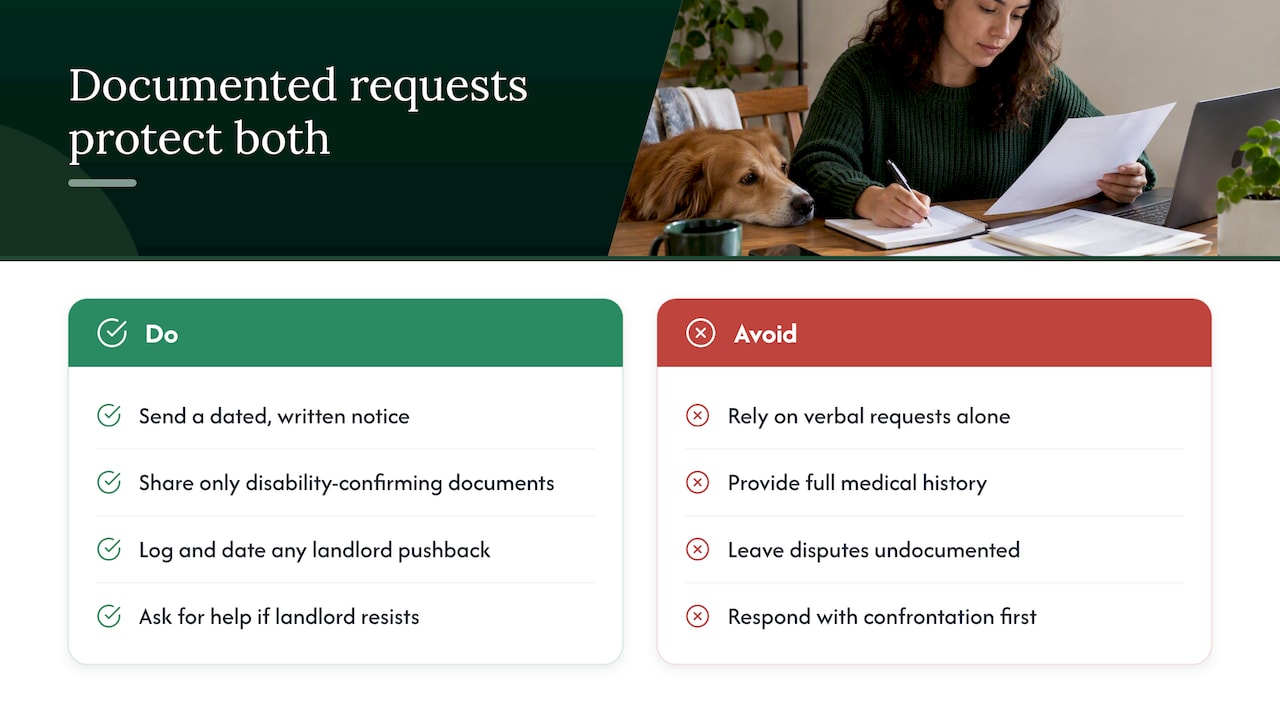
Most disputes I’ve seen trace back to a verbal request that never got written down. A dated, written notice protects you if questions come up later, and it gives the landlord something concrete to respond to instead of guessing at what you need.
Keep your documentation narrow. Share only what confirms the disability-related need, not your full history. If a landlord pushes back unfairly, document it and ask for help. Clear communication tends to resolve more than confrontation does.
— Erik
How this resource can help with your ESA request
Writing the request is the easy part. Knowing exactly what to say, what documentation to offer, and what to hold back is where most renters get stuck, and where a plain-language ESA guide is helpful.
- Templates for written accommodation requests you can adapt.
- Explanations of what a legitimate ESA letter includes and who can write one.
- Warnings about certificate sellers and registries that don’t hold up under FHA guidance.
Visit Supportpet’s ESA rights guide for templates and explanations built to help you avoid the most common disputes before they start.
Sources
For anything beyond this guide, start with the HUD/DOJ reasonable accommodations statement and HUD’s assistance animal assessment guidance. State-level resources, like the California Civil Rights Department’s ESA FAQ, show how federal rules apply locally and are worth checking for your own state’s civil-rights office.
This article is general information, not a substitute for advice from a qualified lawyer. Consult a qualified legal professional about your own circumstances before acting on anything here.
- Reasonable Accommodations under the Fair Housing Act (HUD/DOJ statement)
- Assessing a Person’s Request to Have an Animal as a Reasonable Accommodation Under the Fair Housing Act (HUD)
- Emotional Support Animals and Fair Housing Law FAQ (California Civil Rights Department)
FAQ
Do landlords actually check ESA letters?
Landlords can review documentation you provide to confirm it addresses the required elements, such as a nexus statement and clinician information, but they cannot verify a diagnosis or contact your provider without your consent. Under HUD guidance, their role is to assess whether the documentation reasonably supports the request, not to investigate your medical history.
When can a landlord legally reject an ESA request?
A landlord can only deny a request for specific reasons: the animal poses a direct threat based on documented behavior, granting it would cause an undue financial or administrative burden, or it would fundamentally alter the housing operation. General no-pets policies or breed assumptions, on their own, don’t meet that standard under HUD’s service and assistance animal notice.
Do landlords have to accept emotional support animals?
Under the Fair Housing Act, landlords covered by the law must consider ESA accommodation requests and grant them unless a legitimate denial basis applies, such as direct threat or undue burden. This obligation applies regardless of a building’s no-pets policy, since an ESA is treated as an accommodation rather than a pet.
Does having an ESA go on your record?
There’s no national registry or record created when you request an ESA accommodation. Your documentation stays between you, your clinician, and the landlord reviewing the specific request, and it isn’t reported to any public database.