
You qualify for an ESA when a licensed mental health clinician evaluates you, determines you have a disability-related need, and puts that finding in a current, individualized letter. HUD and fair housing law require that letter for housing accommodations. No registry, certificate, or vest carries legal weight on its own, and an ESA is legally distinct from a trained service animal.
TL;DR:
- A valid ESA letter must come from a licensed clinician who has performed an individualized assessment, not from automated online forms or certificates.
- Conditions like anxiety, depression, PTSD, and bipolar disorder may qualify if they substantially limit major life activities and the animal alleviates that impairment.
- The ESA letter needs to include clinician credentials, a recent date, a specific connection between the animal and treatment, and a signature; generic templates do not hold up legally.
- Landlords cannot charge pet deposits or restrict breed or size for ESAs, unless there is a documented safety concern directly linked to the animal’s behavior.
- Beware of scams offering instant approval, registration, or certificates; always verify the clinician’s license and ensure the assessment was genuine.
Table of Contents
- What Documents Do You Need to Qualify for an ESA?
- Which Conditions Meet the Criteria for an Emotional Support Animal?
- What Must a Valid ESA Letter Include?
- How Do You Get Evaluated and Obtain ESA Documentation?
- What Housing Rights Come With an ESA Letter?
- How Do You Spot ESA Certificate Mills and Scams?
- Which Animals Qualify and What Do Landlords Expect?
- What Actually Separates a Real ESA Case From a Weak One
- Get Clear, Verified Guidance Before You File an Accommodation Request
- Sources
- FAQ
What Documents Do You Need to Qualify for an ESA?
Before you book anything, get your paperwork logic straight. Qualifying isn’t about filling out a form online. It’s about a licensed professional documenting a real clinical relationship between your condition and the animal’s benefit to you.
Here’s what to have ready before and after your evaluation:
- A licensed clinician evaluation. A therapist, psychiatrist, psychologist, or licensed clinical social worker who has actually assessed you, not a form you filled out on a certificate site.
- A completed ESA letter with the clinician’s license information, the date, a statement of disability-related need, and a signature.
- Supporting evidence, if your disability isn’t obvious, such as prior diagnosis records, medication history, or treatment notes.
- Confirmation the clinician is licensed in your state, especially if you used a telehealth provider — this matters more than people realize.
- A plan for renewal, since most landlords expect a letter dated within the past year.
Once you’ve gathered that, the action item is simple: schedule an evaluation with a provider you trust, or find a telehealth service where a licensed clinician actually reviews your history rather than rubber-stamping a questionnaire. The MHA Screening resource on getting an ESA confirms telehealth can produce a legitimate letter, but only when the clinician performs an individualized assessment.
Which Conditions Meet the Criteria for an Emotional Support Animal?
There’s no official checklist of qualifying diagnoses. What matters legally is whether your condition substantially limits one or more major life activities, a standard borrowed from federal disability law. That’s the test landlords and clinicians are actually applying, even when they don’t say it out loud.
Common conditions that lead to ESA letters include anxiety disorders, depression, PTSD, panic disorder, and bipolar disorder. But the diagnosis itself isn’t the qualifying factor. A clinician has to connect the dots: this condition, at this severity, limits this specific activity (sleeping, working, leaving the house, managing daily tasks), and this animal’s presence measurably eases that limitation. LegalClarity’s breakdown of the ESA process makes clear that specific diagnoses are examples, not an exhaustive list. Two people with the same diagnosis can land on opposite sides of the eligibility line depending on how much the condition actually disrupts their life.
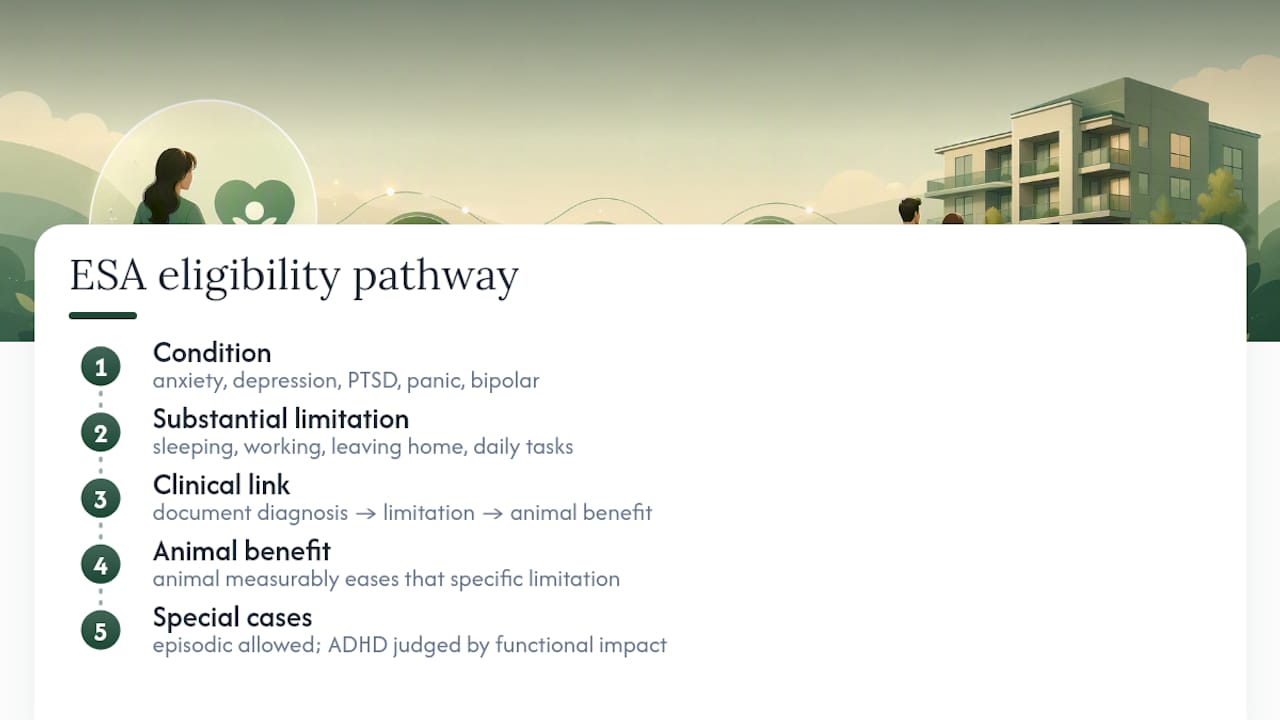
Episodic or remitted conditions complicate this, but they don’t disqualify you. Someone whose depression cycles between manageable and debilitating periods can still meet the disability standard, because the legal test looks at substantial limitation over time, not constant, unbroken impairment. A clinician documenting a history of recurring episodes, along with how the animal helps during flare periods, builds a stronger case than a vague, undated note.
ADHD sits in a gray zone that trips people up. ADHD alone doesn’t automatically qualify someone for an ESA, and it’s worth being honest about that instead of pretending otherwise. What matters is whether the ADHD substantially limits daily functioning in ways connected to the need for an emotional support animal, things like impulse regulation tied to anxiety, sleep disruption, or difficulty managing daily routines that the animal’s presence measurably improves. A clinician evaluating ADHD for ESA purposes should be assessing functional impact, not just confirming a diagnosis you already have on file. If your ADHD comes with co-occurring anxiety or emotional dysregulation, that’s often where the functional case actually gets made.
What Must a Valid ESA Letter Include?
A letter that actually holds up under scrutiny contains specific, non-negotiable elements. Miss one, and a landlord has legitimate grounds to ask questions.
- Clinician credentials: full name, professional title, and license number or state where licensed.
- Date of issue, ideally within the last twelve months.
- A statement of disability-related need, describing that you have a condition that substantially limits a major life activity.
- Language connecting the animal to the treatment, explaining how the ESA alleviates a symptom or supports your functioning.
- A signature, on letterhead when possible, not a stock template with blanks filled in.
The distinction between an individualized letter and a templated one matters more than most people expect. A form letter that never mentions your specific symptoms, history, or functional limitations looks exactly like what it is: a document produced without a genuine clinical relationship. Fair housing guidance from California’s civil rights office notes that reliable documentation comes from an individualized clinical assessment, not from a registry, vest, or ID card purchased separately. Those items carry zero legal standing by themselves.
Pro Tip: Keep a copy of your treatment notes or a benefits statement (like Social Security disability documentation, if applicable) as backup. You may never need to hand it over, but if a landlord pushes back, having a second layer of documentation shortens the argument considerably.
Currency matters too. Most housing providers expect a letter no older than one year, and some request renewal annually even when your condition is chronic. If a landlord asks for more information than the letter provides, they’re generally allowed to request clarification about the disability-related need, though not your full diagnosis or medical file. HUD’s assistance-animal guidance spells out what’s fair to request and where that request crosses a line into an unnecessary medical inquiry.
How Do You Get Evaluated and Obtain ESA Documentation?
The process breaks into four stages, and skipping preparation is the single biggest reason people get denied or delayed.
- Prepare before you book. Write down specific examples of how your symptoms affect daily life, dates of prior diagnoses, medications you’ve taken, and any existing therapy or psychiatric records. Vague self-reporting (“I feel anxious sometimes”) gives a clinician nothing to document.
- Choose the right provider. If you already see a therapist or psychiatrist, start there. If you don’t, and you’re using a telehealth service, confirm the clinician is licensed in your state and that the platform performs individualized evaluations rather than automated approvals.
- Go through the actual assessment. Expect the clinician to ask about symptom history, functional impact on things like sleep, work, and relationships, and how an animal’s presence has helped or could help. A legitimate provider documents this rationale in clinical language, not marketing language.
- Collect and verify the letter. Once issued, check that it includes the license number, date, and specific functional-impact language. Then use it to file a reasonable-accommodation request with your housing provider, ideally in writing, with a copy retained for your records.
Pro Tip: If a provider offers you a letter before you’ve described a single symptom, that’s the clearest signal something’s wrong. Individualized assessment takes time, usually more than one short call.
What Housing Rights Come With an ESA Letter?
A valid ESA letter triggers protection under the Fair Housing Act, which requires housing providers to make a reasonable accommodation for a disability-related need. That protection covers a lot of ground most renters don’t realize applies to them.
- Landlords generally cannot charge pet fees or deposits for a qualifying ESA.
- Breed and size restrictions typically don’t apply to ESAs, unless there’s an individualized safety concern tied to that specific animal’s behavior.
- If your disability isn’t obvious, a landlord may request documentation confirming the disability-related need, but not your full medical history or specific diagnosis.
- A housing provider can deny a request only under narrow circumstances: undue financial or administrative burden, a fundamental alteration to the housing operation, or a documented direct threat posed by that specific animal.
Denials have to be based on individualized evidence, not blanket policy. A landlord can’t reject your ESA request just because the building has a “no pets” policy or because the animal is a species they don’t typically allow. HUD’s guidance is explicit that a blanket refusal without evaluating the specific circumstances runs afoul of federal housing law. If you get denied, ask in writing for the specific grounds, and if the explanation cites a policy rather than an individualized concern, that denial likely doesn’t hold up.
Practically, present your request early, in writing, alongside your letter, rather than after you’ve already moved in with the animal. It gives the housing provider time to process it correctly and gives you a paper trail if things go sideways.
How Do You Spot ESA Certificate Mills and Scams?
The ESA space has a real scam problem, and it costs people money for documents that don’t work when they need them most. Watch for these signals:
- Instant approval. Any service promising a letter within minutes, with no clinical interview, is not performing an individualized assessment.
- ID cards, vests, or “registration” upsells. None of these establish legal entitlement to anything. There is no national ESA registry, and paying for one doesn’t strengthen your legal position.
- Guaranteed approval language. Legitimate clinicians can’t guarantee an outcome before evaluating you, because the outcome depends on your actual clinical picture.
Verify legitimacy before you pay anything. Look up the clinician’s license through your state licensing board, ask directly whether the assessment will be individualized, and request contact information you can reach after the fact if a landlord has questions.
Pro Tip: If a landlord or property manager pushes you toward a specific “quick certification” website, that’s often a red flag about the landlord’s understanding of the law, not a requirement you actually have to meet.
If you suspect you were issued a fraudulent letter, or someone asks you to use one, stop before submitting it anywhere. A rejected accommodation request built on a bad letter can make a legitimate follow-up request harder to process later.
Which Animals Qualify and What Do Landlords Expect?
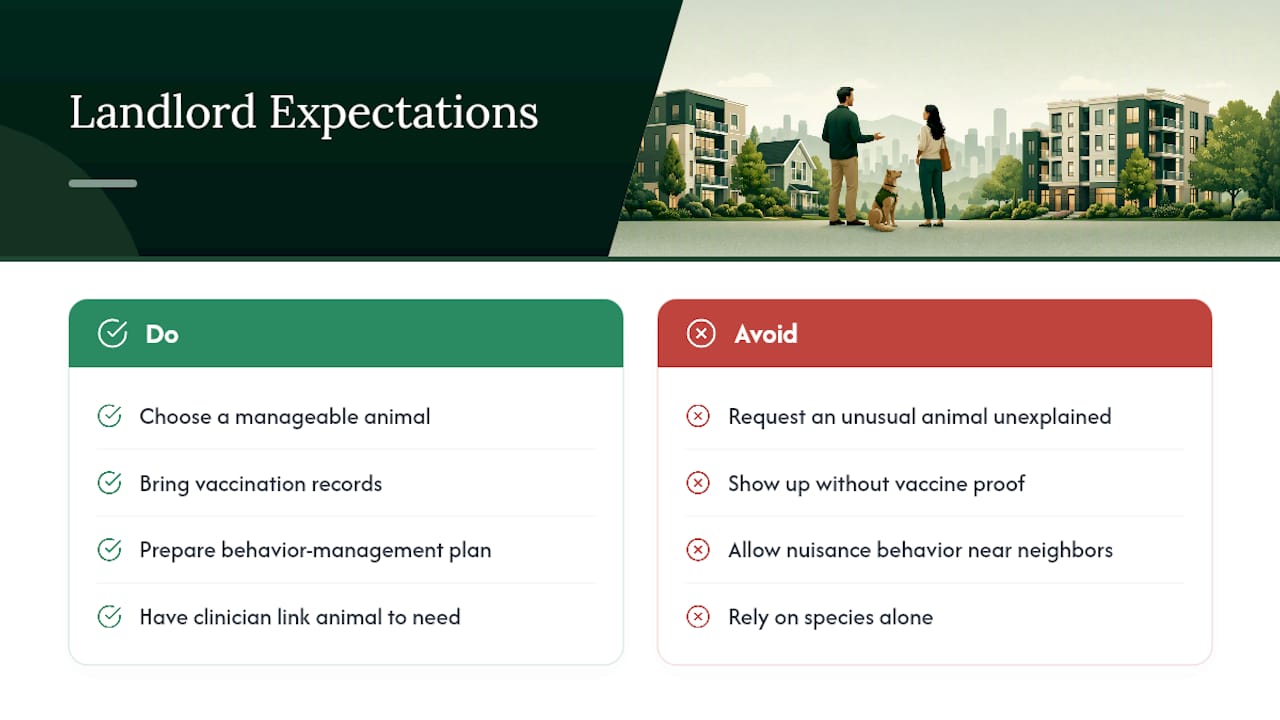
Almost any domesticated animal can serve as an ESA. Dogs and cats are most common, but educational resources on emotional support animals confirm species alone isn’t the determining factor, since an ESA works through presence and comfort rather than trained tasks the way a service animal does.
That said, practical friction is real. Housing providers generally expect the animal to be manageable and not a nuisance to other residents, and proof of vaccination or basic behavioral control often smooths the process even when it’s not strictly required. If you’re requesting an unusual animal, a clinician’s letter should connect that specific animal to your therapeutic need rather than leaving the choice unexplained. Bringing vaccination records and a basic plan for managing the animal’s behavior around neighbors tends to reduce pushback before it starts.
What Actually Separates a Real ESA Case From a Weak One
The gap between people who get approved smoothly and people who get stuck almost always comes down to documentation quality, not the severity of their condition. A well-documented, individualized letter from a licensed clinician typically moves through a housing request with minimal friction, while a generic template letter invites exactly the scrutiny it should have avoided.
A short verification habit solves most of this before it becomes a problem. Look up the clinician’s license, confirm the assessment was individualized rather than automated, keep your treatment notes on hand, and skip anything selling an instant “certificate.” It is important to prioritize licensed clinicians and real clinical assessments over speed, because a fast letter that falls apart under a landlord’s questions helps nobody.
— Erik
Get Clear, Verified Guidance Before You File an Accommodation Request
Supportpet gives you the specific, no-nonsense version of this process: how to confirm a clinician’s license, what a real ESA letter needs to include, and how to avoid paying for a certificate that carries zero legal weight. Instead of guessing whether your documentation holds up, you get a clear reference before you submit anything to a landlord.
If you’re still assembling your paperwork or unsure whether a provider you found online is legitimate, Supportpet’s guide to ESA letters and housing rights walks through verification steps, what HUD actually requires, and how to structure a request that holds up the first time. Start there before you pay anyone for a letter or certificate.
This article is general information, not a substitute for advice from a qualified doctor. Consult a qualified healthcare professional about your own circumstances before acting on anything here.
Sources
- HUD: Assistance animals / housing guidance
- Emotional support animals and fair housing law: FAQ (California civil rights guidance)
- Emotional Support Animals: The Basics (UMass Medical School)
FAQ
What conditions qualify you for an ESA?
There’s no fixed list. Anxiety, depression, PTSD, and similar conditions commonly qualify when a licensed clinician determines the condition substantially limits a major life activity and the animal helps address it.
How can I get approved for an ESA?
Get evaluated by a licensed mental health clinician, in person or through telehealth, who conducts an individualized assessment and issues a dated letter documenting your disability-related need and the animal’s role in addressing it.
Is it hard to get approved for an ESA?
It’s straightforward if your condition genuinely limits daily functioning and you work with a licensed clinician who documents that connection. It gets difficult only when someone tries to skip the clinical assessment with an instant online certificate.
Does ADHD qualify for ESA?
ADHD can qualify, but only when it substantially limits daily functioning in ways a clinician documents. A diagnosis alone isn’t sufficient. The functional impact and its link to the animal’s benefit are what count.