
A valid ESA letter is a signed clinical letter on a licensed provider’s letterhead stating that an animal provides therapeutic benefit tied to a diagnosed condition, along with the provider’s license number, license state, and the date of issue. That combination, not a certificate or registry card, is what landlords rely on to grant a reasonable accommodation under the Fair Housing Act. Everything else, including registration websites and “instant” certificates, carries no legal weight.
TL;DR:
- A legitimate ESA letter must be from a licensed healthcare professional with personal knowledge of the patient, not a certificate or online registration.
- Real letters require the provider’s full name, license details, contact info, specific clinical relationship, and a recent signature on official letterhead.
- HUD’s guidelines limit landlords to requesting only a brief clinical statement linking the disability to the animal’s therapeutic role, with no requirement for diagnosis or registration.
- Fake ESA documents often promise instant approval or lack clinician details, making license verifications and recent consultations essential for legitimacy.
- Airlines no longer recognize ESA letters for cabin access since 2021, and separate policies require specific trained service animals for in-flight accommodations.
Table of Contents
- Sample ESA Letter Templates You Can Adapt
- What Must an ESA Letter Include?
- Who Is Allowed to Write an ESA Letter?
- How Do You Get a Legitimate ESA Letter?
- Common ESA Letter Scams and Red Flags
- What Does HUD Actually Require From an ESA Letter?
- Do Airlines Accept ESA Letters the Same Way Landlords Do?
- How Is an ESA Letter Different From a Service Animal Letter?
- Who Should See Your ESA Letter, and How Should You Share It?
- The Ethical Line Clinicians Should Not Cross
- Where Supportpet Fits Into Your Next Step
- Sources
- FAQ
Sample ESA Letter Templates You Can Adapt
The right template depends on what your landlord actually asks for. Some want a full clinical letter; others accept a shorter verification note. Below are three drafts modeled on the wording clinicians typically use, including the structure in DRCNH’s sample provider letter.
Housing ESA letter (full version):
- [Clinic Letterhead: Name, Address, Phone, License Number]
- Date: [Month Day, Year]
- To Whom It May Concern (or Property Manager’s Name):
- “I am a [licensed clinical social worker / psychologist / psychiatric nurse practitioner] licensed in [State], license #[XXXXXX]. [Patient Name] has been my patient since [date] and I have evaluated them for a mental health condition that substantially limits one or more major life activities. In my professional opinion, [Patient Name]'s emotional support animal, a [species/breed], provides therapeutic benefit that helps mitigate symptoms of their condition. I am recommending this animal as a reasonable accommodation under the Fair Housing Act.”
- Signature, printed name, credentials, and direct contact number.
Brief provider verification note: a two or three sentence version confirming the clinical relationship, the disability related need, and a statement that the animal is part of the treatment plan, useful when a landlord only requests confirmation rather than a full narrative.
Student or dorm housing template: addressed to the campus housing or disability services office, this version should reference the school’s specific accommodation process by name and avoid disclosing the diagnosis itself, since university offices generally only need confirmation of need, not clinical detail.
Redact the specific diagnosis wherever possible. A landlord is entitled to know that a disability related need exists, not the name of the condition, and a good sample emotional support letter protects that boundary by default.
What Must an ESA Letter Include?
A sample ESA letter is only as strong as its details. Missing pieces are the number one reason landlords push back or request “updated documentation.”
- Provider identity: full name, license type (LCSW, PsyD, MD, NP, and so on), license number, and licensing state, printed on official letterhead.
- Direct contact information: a phone number or clinic address a landlord can use to verify the letter is real.
- Statement of relationship: how long the provider has treated the patient, or the date of the most recent evaluation.
- Clinical statement: language confirming a disability related need and that the animal provides therapeutic benefit connected to that condition.
- Date and signature: handwritten or verified digital signature, dated within a reasonable window.
Pro Tip: Aim for a recently dated letter. Landlords often treat older letters as stale and may ask you to get it renewed before approving the accommodation.
Optional extras help too: the animal’s species, a one-line behavior note, and an offer to verify credentials by phone. None of this requires disclosing a diagnosis by name.
Who Is Allowed to Write an ESA Letter?
HUD’s guidance uses broad language, “health care professional,” which covers licensed physicians, psychiatrists, psychologists, licensed clinical social workers, and psychiatric nurse practitioners. Telehealth providers count too, as long as they have what HUD calls personal knowledge of the patient, meaning an actual evaluation happened, not a five-minute questionnaire.
- Recognized providers include psychiatrists, psychologists, LCSWs, LPCs, and psychiatric NPs licensed in your state.
- State licensure matters because landlords or their attorneys sometimes run a quick license lookup to confirm the provider is real and in good standing.
- “Personal knowledge” generally means at least one live consultation, by video, phone, or in person, not a form filled out with no clinician contact at all.
- Letters older than about a year often trigger a renewal request, especially at lease signing.
A PMC review of human-animal interaction research found the evidence for ESAs’ clinical benefit is mixed and often based on small studies, which is exactly why a real clinical relationship, not a rubber stamp, is the standard HUD expects providers to meet.
How Do You Get a Legitimate ESA Letter?
Getting a real letter takes a few days, not five minutes, and that’s a feature, not a flaw.
- Find a licensed provider. Start with an existing therapist or psychiatrist, or a reputable telehealth platform licensed in your state. Services built around clinical documentation for anxiety and depression illustrate the kind of evaluation-first approach a legitimate provider should follow.
- Complete intake and consent forms. Be specific about how the animal supports your daily functioning, not just that you “like having it around.”
- Attend a live consultation. Video or phone works, but it has to be a real conversation where the clinician can form personal knowledge of your condition.
- Receive your signed letter. Expect it on letterhead, dated, and signed, typically within a few business days of the consultation.
Costs vary widely by provider and region, so there’s no single reliable industry-wide number to quote here, but a live evaluation is consistently the deciding factor in whether a letter holds up. If a landlord questions the letter, offer a license lookup or a clinician callback rather than getting defensive.
Common ESA Letter Scams and Red Flags
Fake ESA letter mills exist because they know renters are often desperate and unfamiliar with the rules. The tell is almost always speed. If a site promises a signed letter within minutes of an online quiz, with no live conversation and no visible clinician name, walk away.
- No named clinician, license number, or licensing state anywhere on the document.
- “Instant approval” or same-day guarantees with zero clinical contact.
- Registry certificates, ID cards, or vests sold as if they carry legal weight (they don’t).
- Clinician contact information hidden or withheld until after you pay.
Pro Tip: Before paying anyone, search the provider’s name plus “license lookup” for your state. A real clinician will show up in a public licensing database in seconds.
If you’ve already paid for a fraudulent letter, dispute the charge with your bank, report the site to your state’s consumer protection office, and start over with a properly licensed provider or telehealth service.
What Does HUD Actually Require From an ESA Letter?
HUD’s 2020 Assistance Animals Notice sets the baseline every housing provider is supposed to follow, and it’s narrower than most landlords realize.
- A landlord can request documentation when the disability or need isn’t obvious, but that’s the limit of what they can ask for.
- Landlords cannot require a specific diagnosis, a notarized letter, or registration with an ESA database, according to Department of Justice Fair Housing Act guidance.
- A concise clinical statement connecting the disability related need to the animal is generally sufficient.
- The best move is to submit a written reasonable accommodation request with the letter attached, rather than a verbal ask, so there’s a paper trail if anything is disputed later.
Do Airlines Accept ESA Letters the Same Way Landlords Do?
No, and this catches a lot of travelers off guard. Airlines stopped recognizing ESA letters for cabin access back in 2021, when the Department of Transportation revised its Air Carrier Access Act rules to classify emotional support animals as pets rather than service animals for flight purposes.
That means the housing protections an ESA letter provides under the Fair Housing Act simply don’t carry over to air travel. If you fly with your ESA today, you’re following the airline’s individual pet policy, which usually means pet fees, carrier size limits, and breed or species restrictions depending on the carrier.
Only animals that meet the ADA’s definition of a service animal, meaning they’re individually trained to perform a specific task for a person with a disability, retain guaranteed cabin access without pet fees. An ESA, no matter how detailed the letter, doesn’t meet that bar because ESAs are not task-trained.
Before booking, check the specific airline’s pet policy page rather than assuming your ESA letter will open any doors. Some airlines still show some flexibility for active-duty military or specific circumstances, but that’s airline discretion, not a federal requirement.
How Is an ESA Letter Different From a Service Animal Letter?
The two get confused constantly, and the confusion causes real problems when people mix up their legal protections.
A service animal, under ADA guidance, is individually trained to perform a specific task tied to a disability, guiding someone who is blind, alerting to a medical event, interrupting a panic attack with a trained behavior. Service animals get broad public access rights: restaurants, stores, workplaces, and more. Critically, businesses generally cannot even ask for documentation. They can only ask whether the animal is a service animal and what task it performs.
An ESA does not need task training. Its role is companionship and emotional comfort that helps manage a diagnosed condition, and its legal protections are narrower. ESA rights apply mainly to housing under the Fair Housing Act, not to restaurants, retail stores, or most public spaces. That’s why an ESA letter and a service animal letter are not interchangeable documents, and presenting one where the other is legally required will not hold up.
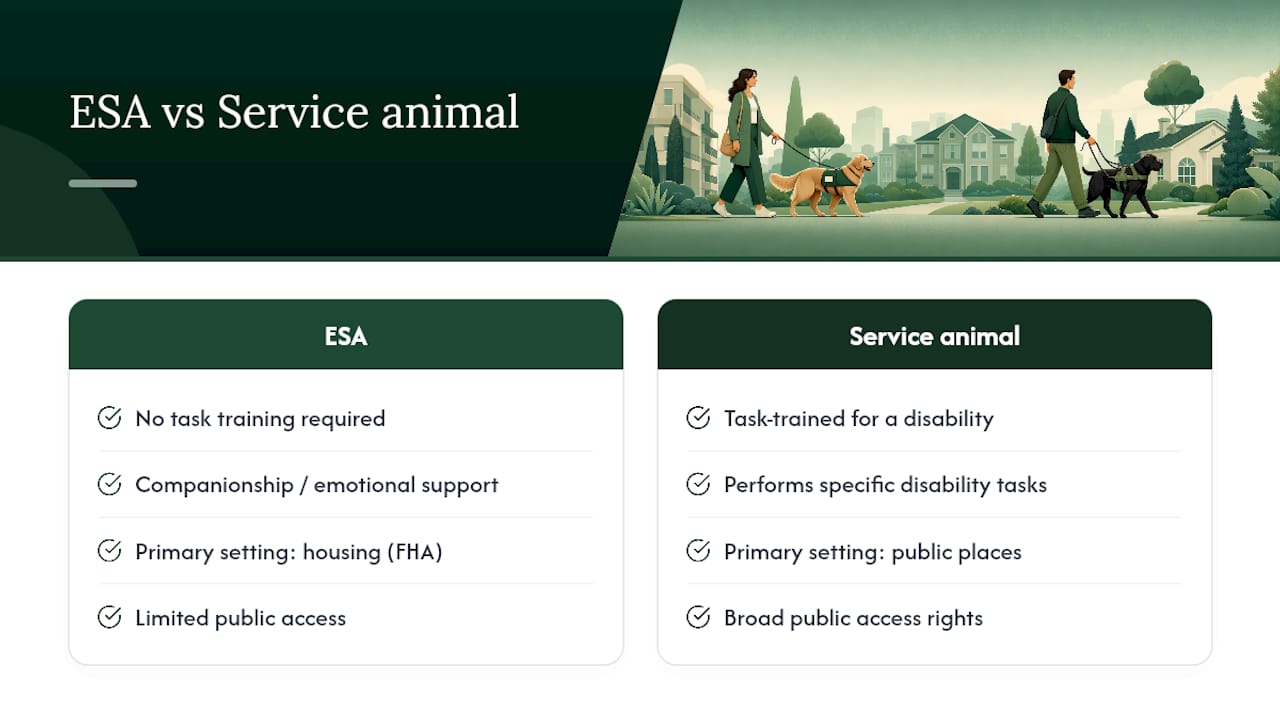
If your ESA also happens to be trained to perform a specific task connected to your disability, it may qualify as a service animal under a separate legal standard, but that requires actual training, not just a diagnosis and a supportive letter.
Who Should See Your ESA Letter, and How Should You Share It?
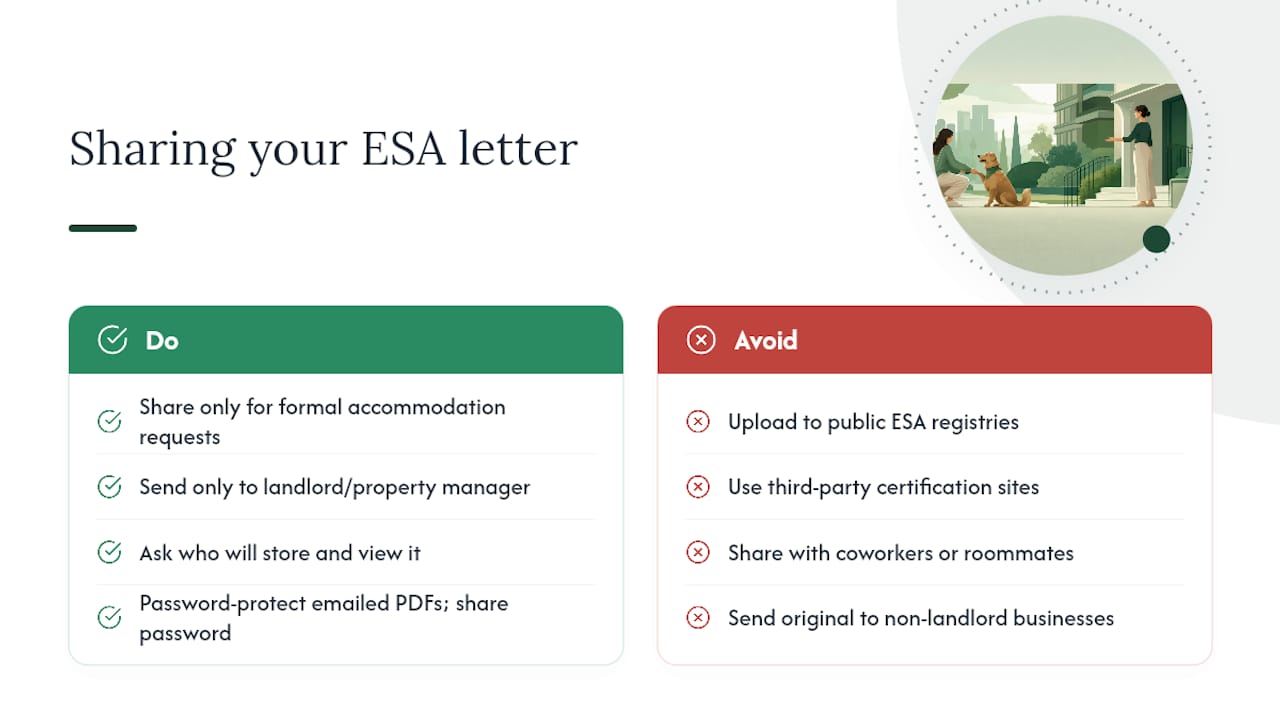
Your ESA letter contains sensitive health information, even in redacted form, so treat it the way you’d treat any medical record. Share it only with the party that has a legitimate reason to request it, typically your landlord or property manager, and only after they’ve formally asked as part of a reasonable accommodation process.
Avoid uploading your letter to public ESA registries or third-party “certification” databases. These sites have no legal standing and often exist mainly to collect personal and financial information, not to help you. A property manager needs the letter itself, not a listing on an unrelated website.
When you do submit it, ask how it will be stored and who inside the property management company will see it. Reasonable property managers keep accommodation documentation in a separate, restricted file rather than a general tenant folder. If you’re emailing a PDF, consider password protecting it and sharing the password separately.
Keep your own copy in a secure location, and never send your original signed letter to a business that isn’t your actual landlord. If a coworker, roommate, or acquaintance asks to see it, you’re under no obligation to share it. It exists to satisfy a specific legal request, not to prove anything to anyone else.
The Ethical Line Clinicians Should Not Cross
Writing an ESA letter without a real evaluation isn’t a shortcut, it’s malpractice risk. The APA’s own resource document tells clinicians to document clinical necessity, weigh the ethical tradeoffs, and revisit the letter periodically rather than treat it as a one-time favor. Good letters come from real assessments, not templates filled in blind.
— Erik
Where Supportpet Fits Into Your Next Step
Sample templates get you most of the way there, but matching your specific situation, a picky landlord, a campus housing office, a lease renewal, to the right wording still takes some judgment. That’s the gap Supportpet’s guides are built to close, with plain language instead of legal jargon and without pushing you toward a certificate mill.
Supportpet’s rights guide and resource library walks through downloadable sample letters, a plain-language breakdown of what HUD actually requires, and pointers on spotting the scam sites this article warned you about. If you’re staring at a lease renewal deadline or a confusing housing office request right now, that’s the place to pull a template, check it against the checklist above, and figure out your next move before you sign anything.
This article is general information, not a substitute for advice from a qualified doctor. Consult a qualified healthcare professional about your own circumstances before acting on anything here.
Sources
- PMC review on human-animal interaction and mental health
- DRCNH: Emotional Support Animal – Sample Provider Letter
FAQ
What Does a Valid ESA Letter Example Look Like?
It’s a signed, dated letter on a licensed provider’s letterhead with their license number and state, a statement of the clinical relationship, and a clear line connecting your condition to the therapeutic benefit of the animal.
Can I Write My Own ESA Letter?
No. A legitimate letter has to come from a licensed health care professional who has actually evaluated you, since HUD’s guidance requires personal knowledge of the patient, not self-certification.
How Do I Get a Legitimate ESA Letter?
Book an intake with an existing clinician or a licensed telehealth provider in your state, complete a real evaluation, and receive a signed, dated letter on their letterhead, usually within a few business days.
What Should My ESA Letter Say?
It should state your provider’s credentials and license number, confirm a disability related need, and explain that your animal provides therapeutic benefit connected to that condition, without necessarily naming the diagnosis itself.