
Only a licensed health professional who has personally evaluated you can write an ESA letter that housing providers are likely to honor. That means a psychiatrist, psychologist, licensed clinical social worker, licensed professional counselor, psychiatric nurse practitioner, or sometimes a primary care physician who already treats you. The one thing that separates a valid letter from a worthless one isn’t the letterhead. It’s whether the clinician actually assessed you and can speak to your disability-related need from firsthand knowledge.
TL;DR:
- Valid ESA letters must come from licensed professionals who have personally assessed you and have an ongoing treatment relationship recognized within their scope of practice.
- Unlicensed individuals, online generators, veterinarians, and generic templates lack the clinical assessment required to meet housing providers’ standards.
- Landlords verify ESA letters through license checks, evaluation of assessment evidence, and timely, clear documentation with proper contact details.
- ESA letters are generally valid for about one year and should be renewed with a brief confirmation of ongoing need from your provider.
- An ESA letter used for housing does not grant access to airlines; airline policies shifted in 2020 to exclude ESAs from special treatment, unlike service animals.
Table of Contents
- Which Licensed Professionals Can Write a Valid ESA Letter
- Who Cannot Legally Write an ESA Letter
- What Federal and State Law Say About Who Can Issue an ESA Letter
- How Landlords Verify an ESA Letter Before Approving It
- How to Get a Valid ESA Letter, Step by Step
- Why Some Clinicians Hesitate to Write ESA Letters
- Red Flags That Signal a Fake or Weak ESA Letter
- ESA Letters for Housing vs. ESA Letters for Air Travel
- How Long Is an ESA Letter Valid, and When Do You Need a New One?
- A Note on Getting This Right the First Time
- Where to Verify the Rules Yourself
- Sources
Which Licensed Professionals Can Write a Valid ESA Letter
Not every clinician who agrees to write a letter is doing it the right way, and not every license type carries the same weight with housing providers. What matters most is scope of practice combined with an actual clinical relationship, not just a credential printed at the bottom of a page.
Psychiatrists and clinical psychologists sit at the top of the list. Both are trained and licensed to diagnose mental health conditions and assess functional impairment, giving their letters the broadest acceptance across housing providers.
Licensed clinical social workers (LCSWs) and licensed professional counselors (LPCs) write the majority of ESA letters in practice, and housing providers generally accept them, provided there’s an established treatment relationship behind the signature. A one-time intake session followed by an instant letter does not meet that bar.
Psychiatric nurse practitioners and psychiatric-mental health nurse practitioners can also issue letters, though scope of practice for nurse practitioners varies by state, and some states require physician collaboration for certain clinical determinations.
Primary care physicians (MD/DO) occupy a gray zone. If a family doctor has managed a patient’s anxiety or depression over time, that physician can document the need for an ESA. But because primary care visits are often brief and not focused on mental health, some landlords scrutinize physician letters more closely than one from a treating therapist.
Across every category, licensure and personal knowledge decide whether a letter holds up. A license without an assessment is just a signature.
Who Cannot Legally Write an ESA Letter
A surprising number of people believe almost anyone with a professional title can sign off on an ESA letter. That belief is exactly what fuels a booming market in worthless documentation.
- Unlicensed counselors, life coaches, clergy members, friends, and family cannot provide documentation that meets HUD’s standard, regardless of how well they know your situation.
- Veterinarians cannot write ESA letters. They’re licensed to treat animals, not to assess human mental health, and a letter from a vet has no legal standing under fair housing rules.
- Online sites that generate an instant letter after a short quiz, with no clinical interview and no ongoing relationship, are widely recognized as scams and get rejected by informed landlords.
- Notarized templates or generic PDFs without a clinician’s name, license number, and contact information are an immediate red flag rather than proof of legitimacy.
A legitimate letter requires that the provider actually performed a professional clinical assessment. Paying a website for a document without any prior evaluation isn’t recognized as a real medical recommendation, and it’s one of the fastest ways to get an accommodation request denied.
Pro Tip: If a website promises a letter within minutes and doesn’t ask a single question about your treatment history, that’s not a clinical assessment. Walk away before you pay anything.
What Federal and State Law Say About Who Can Issue an ESA Letter
Federal guidance sets the floor for what a valid letter looks like, and it’s more specific than most people realize.
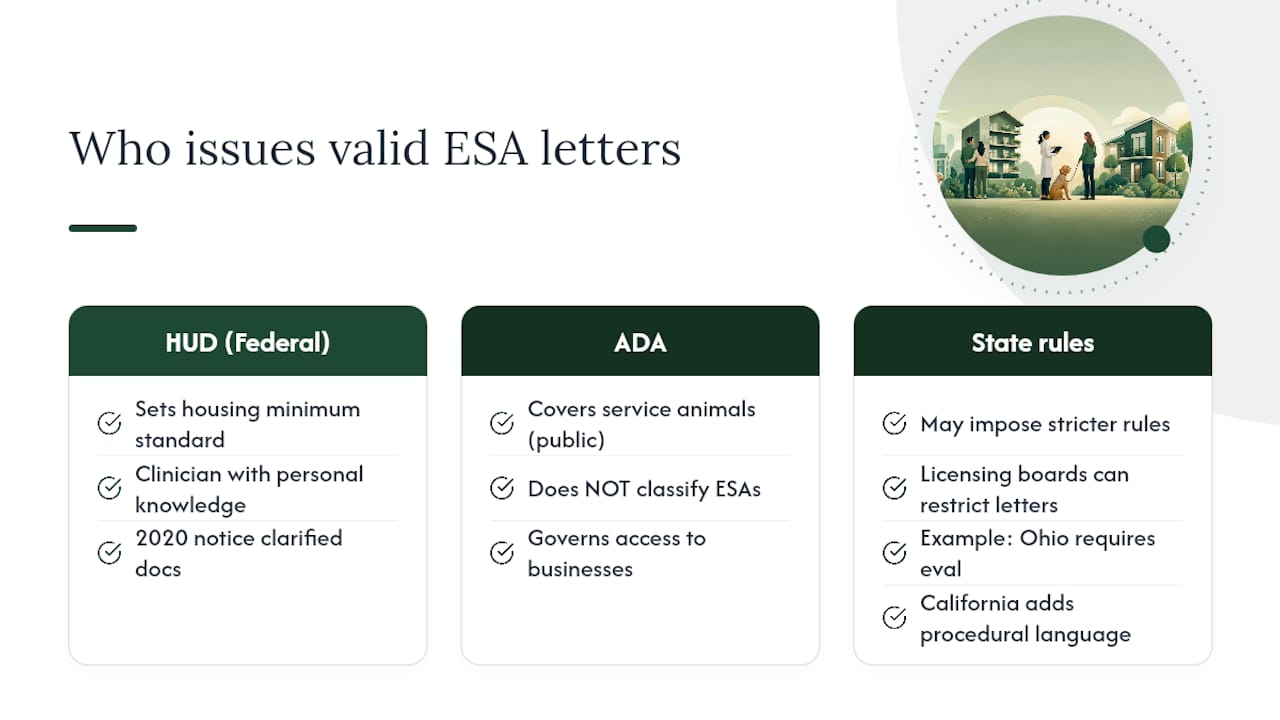
Documentation should come from a health care professional who has personal knowledge of the individual’s disability and their need for an assistance animal, not a stranger reviewing an online questionnaire.
That standard, drawn from HUD’s assistance animal guidance, is the reference point most housing providers cite when they evaluate a request. HUD reinforced this position in a 2020 assistance animals notice that clarified how housing providers should treat documentation.
It’s worth separating ESAs from service animals here, because the two get confused constantly. Emotional support animals are covered under the Fair Housing Act for housing accommodations. Service animals fall under the Americans with Disabilities Act, which governs public access to businesses and other public spaces. An ESA letter that works for an apartment lease does nothing for getting a dog into a restaurant, because the ADA doesn’t classify ESAs as service animals at all.
State licensing boards add another layer. Ohio’s counseling and social work board, for example, has issued guidance advising licensees not to write ESA letters without a meaningful clinical evaluation. California’s housing statutes add their own procedural language around documentation. Readers need to weigh both the federal floor and whatever their state board says, because a letter that satisfies HUD’s minimum standard can still run afoul of a stricter state rule.
How Landlords Verify an ESA Letter Before Approving It
Housing providers rarely take a letter at face value anymore. Enough fake documentation has circulated that most landlords, especially larger property management companies, have a checklist of sorts.
- License verification. Landlords check that the clinician’s license type, number, and state are legitimate and current, often through a public state licensing database.
- Evidence of an actual assessment. A letter that reads like a form template with the patient’s name swapped in raises suspicion; landlords look for language suggesting an ongoing relationship or a real clinical evaluation.
- Timeliness and clarity. A current date, professional letterhead, a clinician’s signature, and a concise statement connecting the disability to the need for the animal all matter more than the letter’s length.
- Follow-up requests. If something looks off, a landlord may ask for additional confirmation. A clinician handling this professionally will respond with clarification rather than treat the request as an attack.
Housing providers dealing with tenant documentation disputes often turn to resources like tenant and landlord rating platforms to understand what’s reasonable to ask for and what crosses a line into harassment.
How to Get a Valid ESA Letter, Step by Step
Getting a legitimate letter takes more effort than filling out an online form, but it’s not complicated once you know the sequence.
- Find a licensed mental health provider. Search for psychiatrists, psychologists, LCSWs, or LPCs in your state, and confirm licensure through your state’s licensing board lookup tool. Telehealth platforms can work, provided the clinician actually conducts an interview and reviews your history rather than issuing a letter on request.
- Prepare before the appointment. Bring a summary of your treatment history, specific examples of how your symptoms limit daily activities like sleeping, working, or leaving the house, and concrete examples of how your animal helps.
- Expect a real clinical interview. A legitimate provider will ask about your mental health history, current functioning, and how the animal fits into your treatment, not just check a box.
- Confirm the letter contains the right elements. Look for professional letterhead, the clinician’s name and license number, a dated signature, and a statement linking your disability to your need for the animal.
Pro Tip: Ask your therapist directly rather than assuming they’ll refuse. Many clinicians write these letters routinely for existing patients once they’ve had a few sessions together. The Supportpet walks through exactly what to bring to that conversation.
Why Some Clinicians Hesitate to Write ESA Letters
Clinicians aren’t being difficult when they push back on a letter request. Most want an established therapeutic relationship and enough assessment data to ethically document a disability-related need, and state boards back that caution up with real consequences for skipping it.
Professional guidance also recommends that clinicians avoid listing a specific diagnosis in the letter itself, favoring language that confirms a disability exists and that the animal provides therapeutic benefit. That approach protects patient privacy while still satisfying HUD’s documentation standard. A responsible clinician will also think about the animal itself, including whether it poses any practical risk, and will document the scope and limits of their own assessment rather than making sweeping claims.
Red Flags That Signal a Fake or Weak ESA Letter
Certain warning signs show up again and again in rejected letters. Missing clinician contact information, no license number anywhere on the page, generic language that could apply to any tenant, and instant approval with no assessment at all are the most common.
- Look up the clinician’s license through your state’s professional licensing board before relying on their letter.
- Report providers issuing letters without any evaluation to that state board.
- If a landlord rejects a legitimate letter, keep written records of every exchange and consider filing a HUD complaint.
A letter obtained by simply paying a website, with no prior clinical evaluation, isn’t recognized as a legitimate medical recommendation and is one of the most frequent reasons housing accommodation requests get denied.
ESA Letters for Housing vs. ESA Letters for Air Travel
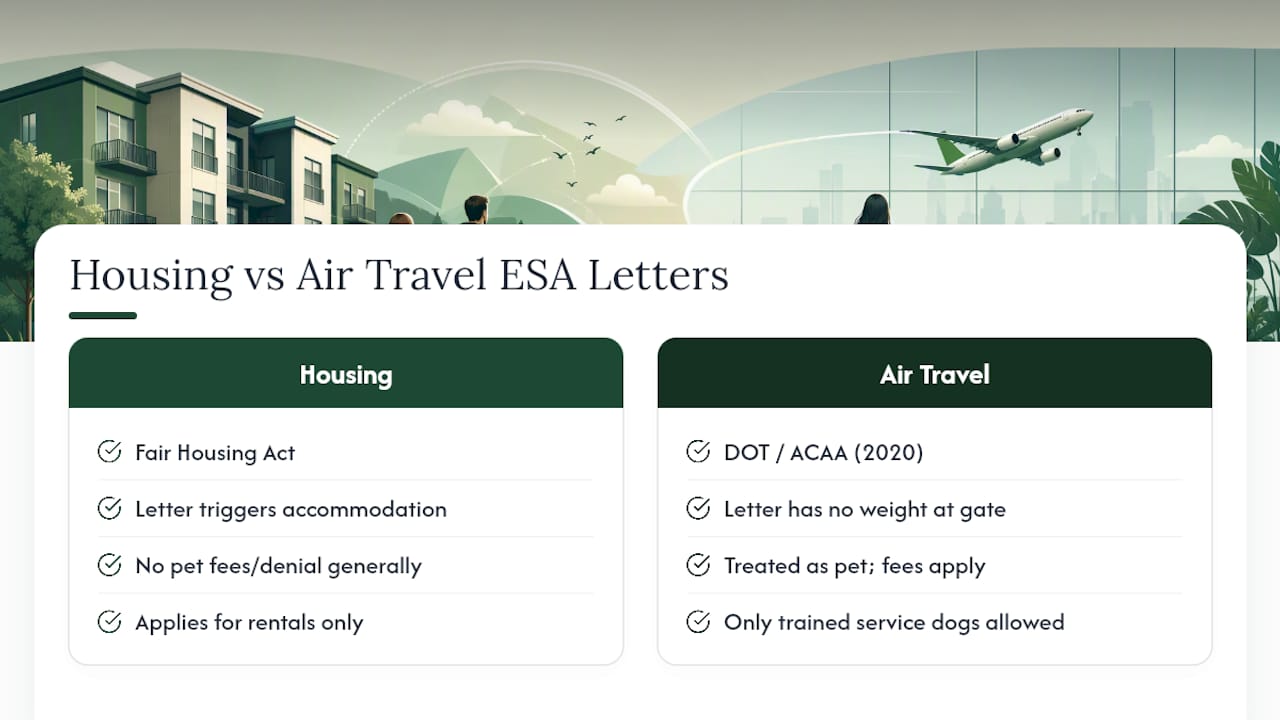
These two situations used to run on similar rules, and they no longer do. Airlines stopped treating emotional support animals as a protected category back in 2020, when the Department of Transportation revised its Air Carrier Access Act rules to only recognize trained service dogs for cabin access without pet fees. That means the ESA letter that gets your apartment approved carries zero weight at the airport gate.
Housing remains the primary place an ESA letter still functions as intended. Under the Fair Housing Act, a landlord generally cannot charge pet fees or deny a reasonable accommodation request for a legitimate ESA, and the letter itself is the documentation that triggers those protections.
If you’re flying with your animal today, expect the airline to treat it as a regular pet, subject to standard pet policies, size restrictions, and fees, unless it’s a trained service animal covered by ADA standards. Some airlines allow small pets in the cabin for a fee regardless of any letter. Confusing the two systems is one of the most common and costly mistakes ESA owners make, especially those who assumed their housing documentation would transfer automatically to a flight booking.
How Long Is an ESA Letter Valid, and When Do You Need a New One?
Most ESA letters are typically considered valid for approximately one year from the date of the clinician’s signature; however, this duration is a general practice rather than a fixed federal requirement. It’s a practical norm that developed because a letter is supposed to reflect your current clinical status, and mental health conditions change over time.
Landlords and property managers often request an updated letter annually, particularly at lease renewal, and some housing providers will accept an older letter if nothing about your situation has changed and your clinician is still your active treating provider. Renewal typically doesn’t require a full new evaluation from scratch if you’re already an established patient. A brief follow up with your clinician confirming continued need is usually enough, which is one more reason maintaining an ongoing relationship with a licensed provider pays off over a one-time transaction with an online letter mill.
A Note on Getting This Right the First Time
The shortcuts around ESA letters exist because people are anxious, in a hurry, or both. But a letter built on a real clinical relationship protects you far better than one built on speed. Clinicians who take the time to actually assess you aren’t creating a hurdle. They’re building the one thing that holds up when a landlord pushes back. Skip the instant-letter sites and find a licensed provider who will actually talk to you about your life.
— Erik
Where to Verify the Rules Yourself
Start with HUD’s assistance animal guidance for the federal housing standard, and the ADA’s service animal resources to understand what ESAs are not covered for. State board pages like Ohio’s CSWMFT guidance show how licensing rules add detail on top of federal law. For a full walkthrough of the process, Supportpet covers qualifying for an ESA and avoiding common documentation mistakes.
If you’re still sorting out where to start, the complete ESA rights guide at SupportPet.org breaks down qualification criteria, sample letter language, and what to expect from a legitimate clinical evaluation, without the sales pitch you’ll find on letter-mill sites.
This article is general information, not a substitute for advice from a qualified doctor. Consult a qualified healthcare professional about your own circumstances before acting on anything here.
Sources
- Points to Consider When Asked to Write Emotional Support Animal Advocacy Letter
- CSWMFT Emotional support animal guidance
- HUD assistance animals resources
- ADA resources on service animals